
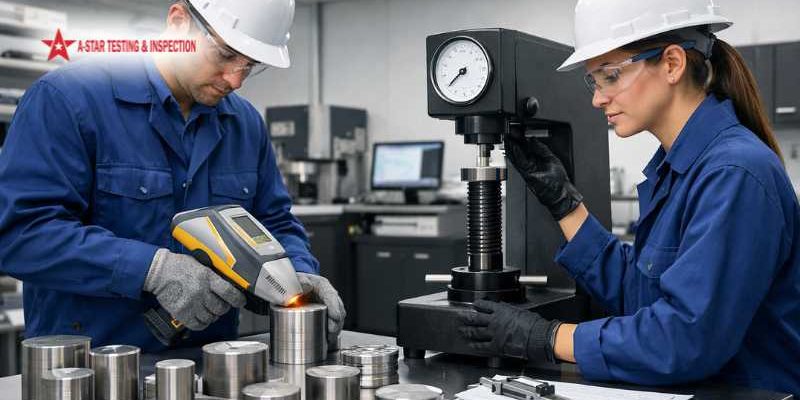
The quality of materials is crucial when it comes to the safety, durability, and performance of the industrial equipment. Such slight changes in material composition or hardness can cause equipment failure, loss of production, or even safety hazards. It is due to this that Positive Material Identification (PMI) & Hardness Testing has become a critical inspection procedure within industries like oil and gas, petrochemicals, power generation, marine, construction, aerospace, and manufacturing.
These inspection procedures can ensure manufacturers, fabricators, and maintenance crews that the right material has been used and that it is of the proper specifications required in the project by checking the chemical composition and mechanical properties of metals. This guide will detail the working of these tests, its advantage, its use in industry, and the standards that are usually adhered to in the course of inspection.
What Is Positive Material Identification (PMI)?
Positive Material Identification (PMI) is a test that is conducted to confirm the chemical makeup of metallic materials and that it is of the appropriate grade of alloy. It aids in identifying materials prior to fabrication, installation, maintenance, or repair, which helps to minimize expensive material mix-ups.
Portable analyzers that offer fast measurements but do not create a lot of damage to the component are used in modern PMI inspections. This qualifies the process to be applied in both field checks and manufacturing plants.
PMI is employed extensively in stainless steel, duplex stainless steel, nickel alloys, titanium, chromium-molybdenum steels, and other specialty metals that are used in demanding industrial applications.
What Is Hardness Testing?
Hardness testing is a measure of the ability of a material to withstand indentation, deformation, or wear. It gives important information concerning the mechanical properties of a metal and is used to identify whether the heat treatment, welding, or manufacturing process has reached the desired hardness level.
The type of hardness testing technique depends on the material, thickness, and usage. These results are useful in verifying the quality of products, measuring the performance of the welds, and ensuring that the results conform to engineering requirements.
How Does the Inspection Process Work?
This inspection is a combination of material checks and hardness checks to make sure that the industrial parts comply with their design specifications.
Step 1: Component Identification
The equipment or component that inspectors need to verify is pipes, valves, flanges, pressure vessels, structural steel or welds.
Step 2: Material Identification Testing
Material Identification Testing is done with portable analyzers that analyze the elemental composition of the metal. The obtained values are compared to the alloy grade.
Step 3: Hardness Measurement
Portable hardness testers or laboratory equipment are used to measure hardness depending on the needs of the project. The results of measurements are matched to acceptance criteria.
Step 4: Result Evaluation
Inspection data is checked to check the adherence to engineering drawings, material certificates, and specifications of the project.
Step 5: Digital Reporting
The results of the inspection are recorded in comprehensive reports which assist in traceability, quality assurance and maintenance planning.
Benefits of PMI and Hardness Testing
These types of inspection are used by industries as they enhance quality control and minimize the risk of operation.
Prevents Material Mix-Ups
Material checks are in place to make sure that the right alloy is mounted in the critical systems.
Improves Equipment Reliability
The correct choice of materials assists components in working as required during working conditions.
Supports Regulatory Compliance
Records of inspection show that there is compliance with the specifications and international quality standards of the project.
Reduces Maintenance Costs
Early warning of improper materials assists in the prevention of costly repairs and unforeseen failures of the equipment.
Enhances Safety
Checking alloy composition and hardness minimizes the chances of failures due to inappropriate materials.
Faster Decision-Making
On-site testing equipment offers quick results, decreasing inspection period and delays in projects.
Industrial Applications
Industrial Hardness testing and the PMI are the most common tests in industries where the material quality directly influences the safety of operations.
Common applications include:
- Pressure vessels
- Storage tanks
- Pipelines
- Heat exchangers
- Refineries
- Petrochemical plants
- Offshore platforms
- Power plants
- Marine structures
- Structural steel fabrication
- Valves and fittings
- Aerospace components
- Manufacturing quality control
The inspections are particularly important when fabricating, performing maintenance, upgrading equipment, and checking incoming materials.
XRF Material Analysis in Modern Inspection
Portable X-ray Fluorescence (XRF) is one of the most popular technologies to use in XRF Material Analysis. The technique is also quick to determine the elemental structure of metallic materials without destroying the part.
The alloying elements can be detected by the XRF analyzers in a matter of seconds, including chromium, nickel, molybdenum, manganese, titanium, copper, and other metals. Due to its speed and portability, XRF has become a solution of choice in the field of inspection and integrity of assets.
Why Alloy Material Verification Is Important
Alloy Material Verification assists industries to verify that all the components are as per the engineering specifications before they are taken into service. Poor quality materials may cause corrosion, early wear, cracking, or disastrous breakdown of equipment.
Regular checking minimizes these risks and helps in long-term equipment performance and maintenance planning.
The Role of Non-Destructive Testing (NDT)
The Non-Destructive Testing (NDT) encompasses a variety of testing methods that do not interfere with the usefulness of materials. Ultrasonic Testing (UT), Radiographic Testing (RT), Magnetic Particle Testing (MT), Liquid Penetrant Testing (PT), and Phased Array Ultrasonic Testing (PAUT are commonly combined with PMI and hardness testing to offer a comprehensive analysis of material health and structural integrity.
The combination of various inspection techniques enhances trust in the quality control and assists organizations in sustaining high standards of their operation.
Industry Standards
PMI and hardness testing are usually carried out as per the established international standards and customer requirements.
Widely used standards are:
- ASTM E572 – Chemical Analysis of Metals.
- ASTM E110- Portable Hardness Testing.
- ASTM E18 -Rockwell Hardness Testing.
- ASTM E10 – Brinell Hardness Test.
- ASTM E384- Microhardness Testing.
- ISO 6506 – Brinell Hardness
- ISO 6507 – Vickers Hardness
- ISO 6508 – Rockwell Hardness
- ASME Boiler and Pressure Vessel Code (BPVC)
Adherence to these standards assists in ensuring consistency in inspection, quality in documentation, and compliance to regulations.
Frequently Asked Questions (FAQs)
Q1. What is the purpose of Positive Material Identification?
Ans: It determines the chemical makeup of metallic materials in order to ensure that the right alloy has been employed in the fabrication process, installation, or maintenance.
Q2. Why is hardness testing important?
Ans: Hardness testing is a determination of the ability of a material to resist deformation and is used to verify that a material is meeting design and heat treatment criteria.
Q3. What industries have PMI in common use?
Ans: PMI is also commonly applied in oil and gas, petrochemical, power generation, marine, aerospace, manufacturing, mining, and construction industries to assure quality.
Q4. Does XRF testing destroy?
Ans: No. Portable XRF analyzers are available, offering instantaneous elemental analysis with minimal harm to the material and thus, the technique is appropriate in field studies.
Q5. Does PMI identify bad alloy grades?
Ans: Yes. PMI is quick in identifying alloy composition and helps in identifying material substitution or incorrect selection of materials before the equipment enters service.
Conclusion
Positive Material Identification (PMI) and Hardness Testing are a necessary component of industrial quality assurance, which allows organizations to establish material composition, assess mechanical properties, and avoid expensive material-related failures. With quick alloy verification and precise measurement of hardness, industries can enhance the reliability of equipment, regulatory compliance, and workplace safety. These inspections can be combined with other Non-Destructive Testing (NDT) techniques to offer a holistic approach to asset integrity management. To provide reliable material verification and industrial inspection services, A-Star Testing & Inspection provides PMI and hardness testing services with the use of modern equipment, qualified staff, and industry-accepted inspection practices, to serve a broad spectrum of industrial applications.