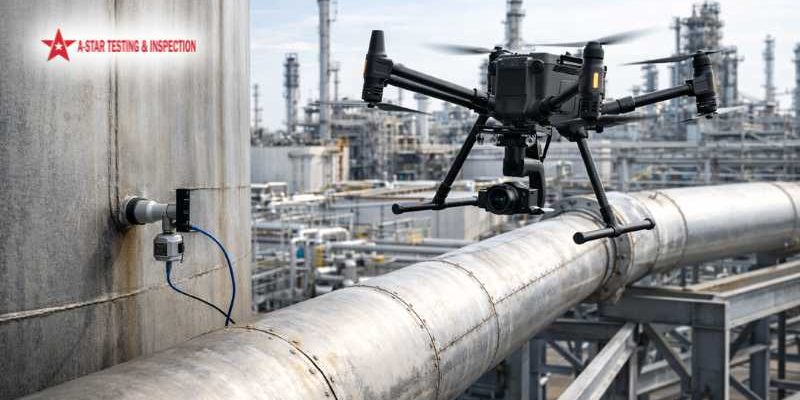
There is a technological renaissance of industrial inspections. Man-entry techniques of inspecting flare stacks, storage tanks, and high-pressure boilers are being replaced by high-precision UAVs. Using UTM (Unmanned Traffic Management) to ensure the safety of the airspace and the Close Visual Inspection (CVI) to guarantee the detail of the microscope, the industrial operators are approaching a new level of control, a feat that was not possible before.
Drone inspection UTM close visual industrial solutions are the latest to change the way inspections are carried out on complex assets and enhance safety, precision, and effectiveness. This reference will discuss the synergy between these technologies and the reasons why they have become the gold standard in industrial drone inspection and UAV inspection services.
What is Drone Inspection in Industrial Applications?
Inspection of industrial drones is a concept related to drones with sophisticated sensors used to measure physical asset integrity. These are no longer flying cameras; they are sophisticated NDT (Non-Destructive Testing) systems that are able to:
- Remote Sensing: Thermal anomalies and gas leaks.
- Automated Flight: Pre-programmed 3D routes to cover all areas.
- Millimeter-Precise Accuracy: With the help of LiDAR and high-zoom optics, it can identify flaws that cannot be seen by the naked eye.
What is UTM (Unmanned Traffic Management)?
Airspace management is becoming a major concern as the industrial environment is becoming more and more used to drone operations. UTM systems are digital air traffic control systems in industrial facilities.
- Safe Airspace Integration: Coordinates a variety of drones and prevents conflicts with manned aircraft.
- BVLOS Support: Allows Beyond Visual Line of Sight flights to pipelines and large facilities.
- Real-Time De-confliction: Proactively reroutes drones in case of airspace conflict.
What is Close Visual Inspection (CVI) Using Drones?
Aerial surveys can give a macro-level picture; Close Visual Inspection (CVI) concentrates on the microscopic level. It includes drone flight around assets or high-power zoom shots to achieve ultra-high-definition shots.
Key capabilities include:
- Weld and Joint Analysis: Checking critical structural welds.
- Surface Defect Detection: Cracks, corrosion, and coating damage detection.
- Contact-Based Sensing: High-technology drones have ultrasonic thickness touch probes.
Why Drone Inspection is Transforming Industrial Inspections
Three advantages that are leading to the transition to drone inspection are:
- Reduced Human Risk: Removes staffing of risky places.
- Enhanced Speed of Inspections: Daily processes can be done in a few hours.
- Cost Efficiency: Saves on costs by doing away with scaffolding and reducing downtime.
Applications of Drone Inspection in Industries
Drone inspection UTM close visual industrial systems are now being necessitated in industries:
- Oil and gas facilities: Refinery, offshore platforms, and flare stacks.
- Power Plants: Boilers and cooling towers are not shut down.
- Infrastructure: Bridges, tunnels, and inaccessible structures.
- Wind Turbines: Checks on erosion and damage of blades.
Key Benefits of Drone-Based Close Visual Inspection
- High Accuracy: Consistent operation even in GPS-denied conditions with SLAM technology.
- Real-Time Analysis: Detection of defects by AI during inspection.
- Less downtime: Allows inspections to be performed without stopping operations.
Drone Inspection vs. Traditional Inspection Methods
The benefits are evident when comparing the drone-based inspections with the traditional processes by hand. UTM and Close Visual Inspection (CVI) of drones are much safer because it is conducted remotely, and the employees are not required to operate the equipment on hazardous levels. Conversely, manual inspection procedures usually have moderate to high risks to safety. As for speed, drone inspections can be done in a matter of hours compared to the traditional methods that may require days or even weeks. Another significant differentiator is data quality: drone inspections deliver digital and geo-tagged and repeatable data; manual inspections use subjective data and handwritten notes. On the cost front, drone inspections are much more cost-effective since they do not require the use of scaffolding or man-lifts.
Safety and Compliance in Drone Inspection
Compliance in drone inspection goes beyond basic permissions:
- UTM Integration: Makes sure that all drone operations are monitored and approved.
- Certification: The operators should be licensed and trained to the standards of industrial inspection.
- Cybersecurity: Transmission of sensitive industrial data is secured.
Drone Inspection Services: How to Choose the Right Provider
To choose a drone inspection provider, take into account:
- Specialized Equipment: Ability to carry out CVI under extreme conditions.
- Software Integration: Capability to provide AI-based reports and digital twins.
- Experience in the industry: Understanding of industry-specific risks and needs.
Select qualified personnel to do proper and precise inspections.
Cost of Drone Inspection Services
The costs of drone inspection depend on the scope and complexity. Although the per-day rate can be greater than hand inspection, the overall project cost is much less as a result of:
- Reduced downtime
- No ladders or machinery.
- Early identification of key problems.
Future of Drone Inspection in Industry
Intelligent automation is the future of industrial inspection:
- Autonomous Inspections: Drones that conduct regular inspections without human control.
- AI-Based Diagnostics: Historical data comparison to identify trends of corrosion and anticipate failures.
Conclusion: Smarter, Safer Industrial Inspections with Drones
The drone inspection UTM close visual industrial technology, has revolutionized the industrial inspection strategies. The integration of UAV systems with the advanced airspace control and high-resolution inspection will allow industries to enhance safety, work efficiency, and cost control to a great extent.
Adopting drone inspection UTM close visual industrial solutions enables organizations to gain a competitive edge in protecting asset integrity and operational reliability.
Modernize your inspection plan using hi-tech drone inspection solutions.
Frequently Asked Questions (FAQ)
Q1. Are drones able to work in GPS-deprived areas?
Ans: Yes, industrial drones in modern industry have LiDAR and SLAM-based navigation systems that enable them to work effectively without GPS.
Q2. What is the nearest distance that drones can go during inspection?
Ans: Drones can fly safely within 30 cm to 1 m off a surface, or can make a close look with high optical zoom, at a distance.
Q3. Are industrial drone operations mandatory to use UTM?
Ans: UTM is to be used in most of the areas to guarantee safe and legal utilization of airspace.
Q4.How long does an industrial drone normally take to fly?
Ans: The typical flight time of drones is 20-40 minutes per charge, and tethered drones can be used to offer unlimited flight.
Explore our NDT services
Conventional NDT · Advanced NDT · Tank Inspection · Rope Access NDT · In-Service Inspection