
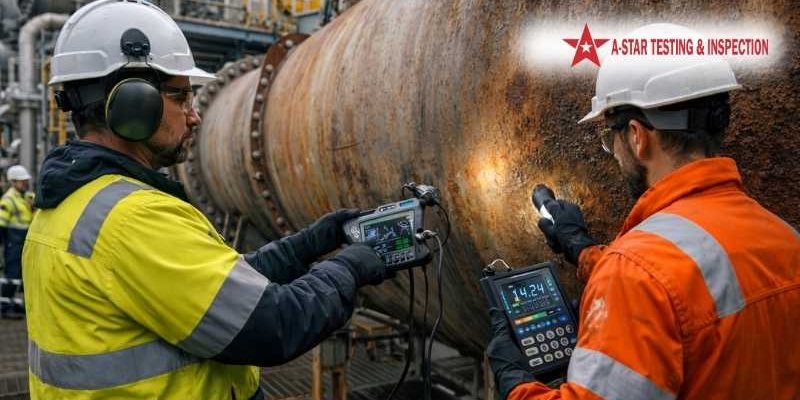
Pressure equipment is essential in the oil and gas, petrochemicals, power generation, manufacturing, food processing, and pharmaceutical industries. Pressure vessel and storage tanks are built to securely hold liquids, gases, or chemicals under different pressure and temperature circumstances. These assets are usually subjected to harsh conditions; thus, periodic inspection, testing, and maintenance are necessary to ensure that defects do not evolve into costly failures.
This guide outlines how such industrial assets are inspected, the testing procedures employed, the best practices in maintenance, and the safety measures that the organizations must adopt to enhance efficiency in operations and the life of its equipment.
What Are Pressure Vessels and Storage Tanks?
Pressure vessels are closed containers that are designed to contain gases or liquids with pressures that are much higher or lower than the atmospheric pressure. They are widely used in boilers, heat exchangers, reactors, separators, and compressed gas systems.
Storage tanks, in their turn, are intended to hold liquids, chemicals, petroleum products, water or gases. They can be above ground, underground, vertical or horizontal depending on the needs of the operation.
They are different in terms of their functions, but they should be regularly checked to be in the proper state of condition to ensure structural integrity and operational safety.
Why Regular Inspection Is Important
The stress on industrial equipment is continual, as it undergoes changes in pressure, temperature, corrosion, vibration, and exposure to the environment. The minor flaws will develop into severe structural issues without regular Pressure Vessel Inspection and Storage Tank Inspection.
Periodic checks facilitate organizations:
- Early warning of corrosion.
- Detect defects such as cracks, leaks, and welds.
- Reduce unexpected shutdowns
- Improve equipment reliability
- Extend service life
- Support regulatory compliance
- Minimize repair costs
- Improve workplace safety
Preventive inspections can be more cost-effective than emergency repairs or equipment replacement.
Common Inspection Methods
The choice of different inspection methods depends on the type of equipment, material, working environment, and availability.
Visual Inspection (VT)
The initial step is to visually examine. Corrosion, coating damage, leakage, deformation, dents, bulging, and visible weld defects are some of the corrosion and coating defects that inspectors seek.
Ultrasonic Testing (UT)
Ultrasonic testing: This is a method used to measure the remaining wall thickness and internal flaws without causing any damage to the component. It is mainly applicable in tracking the loss of corrosion as time progresses.
Magnetic Particle Testing (MT)
The procedure identifies surface and near-surface cracks in ferromagnetic materials, particularly at welds and high-stress points.
Liquid Penetrant Testing (PT)
PT can detect minute surface-breaking defects in non-porous materials in which a visual check might not show any discontinuity.
Radiographic Testing (RT)
Radiographic inspection is a technique that involves the use of X-rays or gamma rays to help in the detection of internal weld defects, porosity, lack of fusion, and inclusions without the dismantling of equipment.
Advanced Inspection Techniques
New facilities are incorporating new technologies like:
- Phased Array Ultrasonic Testing (PAUT)
- Time of Flight Diffraction (TOFD)
- Digital Radiography (DR)
- Computed Radiography (CR)
- Drone-assisted visual inspection
- Acoustic Emission Testing (AET)
These techniques offer more coverage of inspection and less downtime.
The Role of Non-Destructive Testing (NDT)
Non-Destructive Testing (NDT) enables inspectors to test equipment without cutting, dismantling, or disrupting normal performance. It is crucial in preventive maintenance programmes in the industrial sectors.
Advantages of NDT are:
- Early defect detection
- Improved inspection accuracy
- Reduced production interruptions
- Lower maintenance costs
- Better documentation
- Longer equipment lifespan
- Enhanced operational safety
In a vast number of industries, a set of NDT techniques are combined to provide a comprehensive picture of the state of the asset.
Pressure Vessel Testing Procedures
Routine Pressure Vessel Testing ensures that the equipment is still fit to continue being used.
Common testing activities are:
Thickness Measurement
Ultrasonic thickness surveys are used to check the loss of materials due to corrosion or erosion.
Weld Integrity Assessment
Welds that are critical are checked for both internal and surface defects through radiographic or ultrasonic checks.
Leak Testing
Leak tests ensure that pressure limits are not broken and can still retain the operating media safely.
Hydrostatic Testing
Water is pumped into the vessel, and it is pressurized to a pressure higher than that of its operation to ensure structural integrity and to test for leaks.
Internal Examination
Inspectors perform inspections of corrosion, scaling, deposits, cracking, and mechanical damage in the vessel during scheduled shutdowns.
Best Practices for Industrial Storage Tank Maintenance
Effective Industrial Storage Tank Maintenance is concerned with the prevention of deterioration prior to impacting operations.
Maintenance practices that are recommended are:
- Carry out routine visual checks.
- Keep track of the rate of corrosion.
- Check weld joints and sprues.
- Maintain protective coatings
- Clean tanks periodically
- Check foundation settlement
- Test safety valves and accessories
- Maintain records of inspection.
- Fix small issues in a timely manner.
- Follow manufacturer recommendations
A proactive maintenance approach will greatly minimize the chances of unforeseen failure.
Important Safety Standards
A number of internationally acknowledged standards are used to ensure organizations maintain safe operation of pressure equipment.
Some of the standards that are often adhered to are:
- ASME Boiler and Pressure Vessel Code (BPVC)
- C510 Pressure Vessel Inspection Code.
- API 653- Tank Inspection, Repair, Alteration, and Reconstruction.
- API 650 Welded Storage Tanks.
- ISO 9712 – Qualification of NDT Personnel.
These standards can be used to enhance consistency of inspections, equipment reliability and regulatory compliance.
Signs Your Equipment Needs Immediate Inspection
Never put off planned maintenance in case any of the following warning signs are noticed:
- Visible corrosion
- Product leakage
- Bulging or deformation
- Unusual vibration
- Sudden pressure loss
- Coating failure
- Weld cracking
- Foundation settlement
- Excessive wall thinning
- Unexpected process interruptions
Timely research may help to avoid costly maintenance and downtime.
Frequently Asked Questions (FAQs)
Q1. What is the frequency with which pressure vessels are to be inspected?
Ans: The frequency of inspection is based on the operating conditions, industry regulations, the age of equipment, and the past results of the inspection. A large number of facilities adhere to API or ASME directions to decide the time interval of inspection.
Q2. What is the importance of storage tank inspection?
Ans: The inspection of storage tanks assists in the detection of corrosion, defects in welds, leaks, settlement, coating damage, and structural damage prior to their influence on safety or production.
Q3. What are the pressure equipment NDT methods?
Ans: Widely used methods are Ultrasonic Testing (UT), Radiographic Testing (RT), Magnetic Particle Testing (MT), Liquid Penetrant Testing (PT), PAUT, TOFD, and Visual Testing (VT).
Q4. What is the purpose of hydrostatic testing?
Ans: Hydrostatic testing ensures a vessel can safely operate at the maximum pressure it is designed to operate at, with no leakage or structural failure.
Q5. Is regular maintenance an effective way to extend equipment life?
Ans: Yes. Regular checks, corrosion control, regular repairs, and preventative maintenance can be used to prolong equipment service life and minimize unexpected downtime.
Conclusion
Pressure vessel and storage tanks are common features in most industrial plants, and as such, frequent inspection, testing, and maintenance are very important to ensure safe and efficient operations. Integrating visual checks with modern inspection systems and properly designed maintenance systems enables companies to identify defects in the initial stages of their development, implement strategies to minimize operational risks, and make optimal use of their assets. Reliability, longer equipment life, and consistent safety in operational activities are some of the benefits that the business can achieve by observing established standards that govern the industry and being proactive in asset integrity management.