
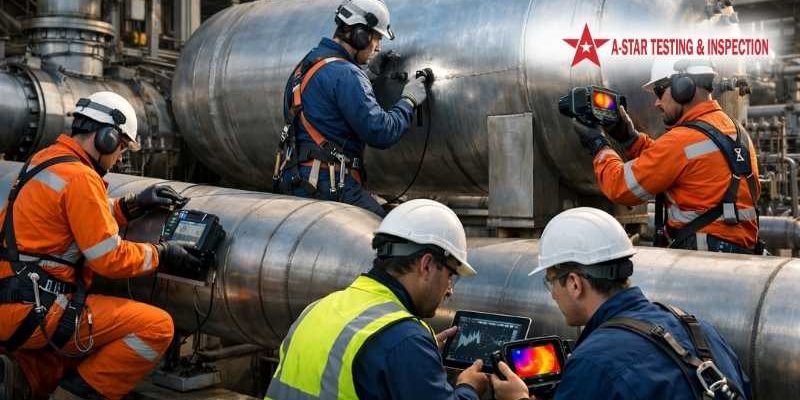
Equipment reliability, operational safety, and compliance with regulations are more of a concern in the industrial landscape than ever before. The oil and gas, power generation, manufacturing, petrochemicals, infrastructure, and marine engineering industries are critical assets that need to operate effectively under arduous environments. Even slight imperfections may result in unplanned downtimes, expensive maintenance, safety risks, and loss of production.
That is why Non destructive testing using ECT, VT, and Thermography has become a significant component of the contemporary inspection and maintenance program. Such high-tech inspection methods enable engineers to identify flaws, check the conditions of assets, and any possible failures without breaking equipment and disrupting the processes.
This guide will discuss the partnership between Eddy Current Testing (ECT), Visual Testing (VT), and Infrared Thermography to promote high-level defect detection and the reliability of assets.
Understanding Non-Destructive Testing (NDT)
Non-destructive testing can be defined as testing techniques that are applied to materials, parts, and equipment in order to assess them without harming them. Modern Non-Destructive Testing (NDT) Services can assist industries in finding latent defects and maintaining assets in service.
The main aims of NDT are:
- Detecting defects early
- Preventing equipment failures
- Improving operational safety
- Supporting preventive maintenance
- Extending asset lifespan
- Ensuring regulatory compliance
ECT, VT, and Infrared Thermography are some of the most efficient NDT techniques implemented in the present day.
What Is Eddy Current Testing (ECT)?
Eddy Current Testing is an electromagnetic test that is applied in identifying surface and near-surface defects in conductors.
When the inspection is carried out, electromagnetic currents are caused to flow through the test material. Variations of these currents are used to detect defects like corrosion, cracks, thinning of the wall, and degradation of materials by the inspectors.
Benefits of ECT
Fast and Accurate Inspection
ECT has the ability to quickly evaluate numerous components without interfering with operations.
High Sensitivity
The method is quite efficient in revealing tiny faults that otherwise could not be visible with the traditional inspection method.
Non-Invasive Testing
It is possible to do an inspection without harming the equipment under test.
The services of professional ECT eddy current testing in India are popular in industries that involve accuracy in detecting defects and monitoring conditions.
Applications of Eddy Current Testing
The modern Eddy current Testing (ECT) Services are generally applied to:
- Heat exchanger tubes
- Condensers
- Boilers
- Aircraft components
- Pipelines
- Structural components
A qualified ECT Tube Inspection Services Company in India can test thousands of tubes in the most efficient way, assisting companies to avoid leakages and enhance the reliability of equipment.
Pulsed Eddy Current for Insulated Pipes
Pulsed Eddy Current (PEC) for Insulated pipes is one of the most developed uses of eddy current.
In many cases, traditional inspections involve removing insulation prior to carrying out testing. PEC technology enables the inspector to determine the level of corrosion and thinning of the walls using the layers of insulation.
Advantages of PEC Inspection
- Reduced inspection costs
- Faster asset assessment
- Minimal operational disruption
- Improved corrosion detection
- Enhanced maintenance planning
PEC is now a significant solution to industries that deal with large systems of piping.
What Is Visual Testing (VT)?
One of the oldest methods of NDT and the most commonly used is Visual Testing (VT) Inspection. Although it is a simple step, it is a very important initial step in numerous inspection programs.
VT entails direct or remote inspection of equipment, structures, and parts to observe visible evidence of damage.
Defects that are usually identified by VT
- Surface cracks
- Corrosion
- Misalignment
- Weld defects
- Coating damage
- Mechanical wear
High-tech equipment, including drones, borescopes, and digital imaging systems, has made the modern visual inspection much more effective.
Infrared Thermography Inspection: Detecting Hidden Problems
Numerous defects in industries produce heat patterns that are abnormal well before the formation of visible damages. Infrared Thermography Inspection would be very useful here.
Infrared cameras are employed in thermography to record variations in temperature on the surfaces of the equipment.
Common Applications
Electrical Systems
Recognizes overheating connections, transformers, switchgear, and circuit parts.
Mechanical Equipment
Identifies high friction, bearing failures, and misalignments.
Process Equipment
Monitors heat exchangers, tanks, pipelines, and insulation performance.
Building Inspections
Determines moisture intrusion, insulation insufficiencies, and energy loss.
Thermography is a non-contact inspection solution that increases safety and maintenance planning.
Why Industries Are Adopting Advanced Defect Detection Technologies
Conventional methods of maintenance tend to use reactive maintenance after a failure has taken place. Contemporary industries are moving towards predictive and condition-based maintenance approaches.
The advantages of Advanced Defect Detection.
- Reduced downtime
- Lower maintenance costs
- Improved worker safety
- Increased equipment reliability
- Better asset performance
- Enhanced regulatory compliance
ECT, VT, and thermography used together are a complete picture of the condition of assets and their health.
Industries That Benefit from ECT, VT, and Thermography
The methods of inspection are common in various industries.
Oil and Gas Industry
Testing of pipelines, storage tanks, heat exchangers, and pressure vessels.
Power Generation
Turbine, boiler, electrical, and condensers.
Manufacturing
Monitoring of equipment condition and quality assurance.
Petrochemical Facilities
Identification of corrosion, leakages, and thermal aberrations.
Marine and Offshore Operations
Evaluation of components of the structure, piping systems, and key assets.
These technologies are versatile and can be used in virtually any industrial setting.
Future Trends in Non-Destructive Testing
The NDT sector is on the way to transformation with the use of digital transformation and improved analytics.
Emerging Technologies
- AI-powered defect recognition
- Automated inspection systems
- Digital asset monitoring
- Remote inspection technologies
- Predictive maintenance platforms
- Real-time condition monitoring
Such innovations are assisting industries to enhance the accuracy of inspection and efficiency.
Frequently Asked Questions (FAQs)
Q1. What is Eddy Current Testing used for?
Ans: ECT is utilized to identify corrosion, cracks, thinning of the walls, and other defects in conductive materials.
Q2. Is Eddy Current Testing able to test insulated pipes?
Ans: Yes. Pulsed Eddy Current technology has the capability of assessing the conditions of pipes without removing insulation.
Q3. What are the flaws that Visual Testing can detect?
Ans: Visual inspection can identify cracks, corrosion, coating damage, weld defects, and any other structural defects that can be seen.
Q4. What is the method of working of Infrared Thermography?
Ans: Infrared cameras are employed in thermography to detect temperature changes that might be a result of a defect or equipment fault.
Q5. What is the importance of NDT services to industries?
Ans: NDT services are used to enhance safety, minimize downtime, increase equipment lifecycle, and assist in regulatory compliance without harming equipment.
Conclusion
With the increasing complexity of industrial assets and the growing importance of operational reliability, sophisticated inspection techniques have become a very important component in contemporary maintenance practices. Eddy Current Testing, Visual Testing, and Infrared Thermography are some of the technologies that are useful to give insights on the condition of equipment without causing much interference to the operations.
Through the introduction of non-destructive testing using ECT, VT, and Theremography in the inspection and maintenance programs, organizations can now detect defects more effectively and enhance the reliability of their assets, minimize maintenance costs, and improve the overall safety performance. These high-tech NDT methods, when used together with predictive maintenance programs, can enable industries to become more efficient in their operations and ensure their long-term asset integrity.
Related NDT Services
Advanced NDT · Tube Inspection · ECT Tube Inspection
Frequently Asked Questions
What is Eddy Current Testing (ECT)?
ECT uses electromagnetic induction to find surface and near-surface cracks and corrosion in conductive materials, and is widely used for heat-exchanger tube inspection.
What is thermography in NDT?
Infrared thermography detects heat patterns to find insulation defects, hot spots and delamination without contact.
What does Visual Testing (VT) cover?
VT is the first-line inspection of surfaces, welds and coatings for cracks, corrosion and workmanship, often supported by borescopes for restricted access.