
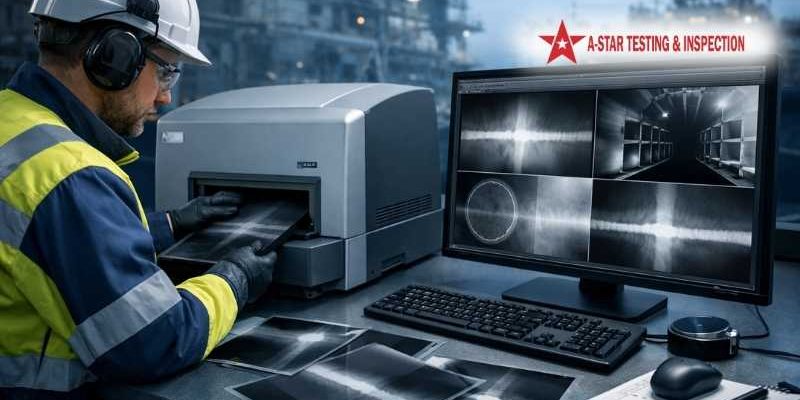
Radiographic film has historically been the standard of documenting the integrity of welds and structural well-being in the traditional world of Non-Destructive Testing (NDT). Nevertheless, due to the shift in the Marine and Offshore industries to a future with the Digital Twin, the weaknesses of physical film (e.g., degradation, storage, and slow retrieval) have become a liability.
Film Digitization Services provides a radical transition between the old-fashioned checks and new data management. Shipyards, offshore operators, and managers of pipelines can also make sure that their vital inspection data is safe, searchable, and ready to be analyzed by converting hardcopy RT films into high-resolution files that are compatible with the DICONDE standard.
What Are Film Digitization Services in NDT?
The essence of industrial film digitization The digitization of analog radiographic films is done using high-end, medical grade, or industrial scanners. This is not a mere scan of a photograph, but rather, a scan of the complete dynamic range and optical density of the original silver-halide film.
Examples of NDT film digitization services include the fact that all fine details, such as porosity, inclusions, hairline stress cracks, and others, are captured in a digital medium. With these digital RT records, one can:
- Digital Radiography Conversion: Transitioning from physical archives to cloud-based servers.
- Enhanced Analysis: Using software to adjust contrast and brightness for better defect characterization.
- Long-term Archiving: Eliminating the risk of film “yellowing” or fading over decades.
Why Film Digitization is Critical for the Marine & Offshore Industry
The sea is known to be hostile. The foes of physical radiographic film are salt air, humidity, and changes in temperature.
1. Offshore Asset Integrity
Offshore platforms have a life span of 20 to 50 years. By storing offshore radiography film scans in digital format, the engineers working in 2045 would be able to review a scan of a weld made in 2026 and see it as clear as it was the day it was made.
2. Shipyard Efficiency
Digitization of marine inspection film in busy shipyards gives various departments, such as the class surveyors and repair staff, access to the same inspection record on various monitors, and speeds up the decision-making process of whether to put a ship back into service.
3. Regulatory Compliance
The digital documentation becomes more and more popular among the international bodies (such as ABS, DNV, and Lloyd’s Register) due to its traceability and simplicity to audit. The NDT film scanning services help you to achieve these changing standards.
Industries Benefiting from Industrial Film Scanning
We have many clients in the heavy industries throughout India and the world:
- Marine and Shipyards: Electrifying the ship hull weld inspection records and structural scan to monitor aging and fatigue.
- Oil & Gas (Offshore): Automation of offshore pipeline radiography digitization process to detect internal corrosion and weld integrity over thousands of kilometers.
- Power Plants: Multipurpose storage of film for industrial inspection of boilers, turbines, and high-pressure steam lines.
- Petrochemical Industry: Transforming the records on radiography of pipeline welds to promote safety in the volatile conditions.
How the Film Digitization Process Works
A-Star is committed to the best data integrity, which is achieved after a multi-step process:
- Film Collection & Preparation: The physical films are cataloged and dusted off, and made ready to be scanned in high-resolution.
- High-Resolution Radiographic Scanning: Industrial-grade laser scanners compliant with ISO 14096 standards are used.
- Digital Image Enhancement: The use of filters to enhance visibility without changing the original scan of the image.
- Quality Control: The digital output should be compared with the physical film to make sure that no information is lost.
- Data Management: Posting files onto a secure digital RT record management system with metadata to be searched (vessel name, weld ID, date).
Key Benefits: Film Digitization vs. Traditional Storage
| Feature | Traditional RT Films | Digital RT Records |
| Storage Space | Massive climate-controlled warehouses | Secure cloud or local servers |
| Durability | Vulnerable to moisture, heat, & chemicals | Immortal; backed up in multiple locations |
| Retrieval Speed | Hours or days (manual search) | Instant (search by keyword) |
| Sharing | Physical shipping required | Instant global sharing via secure links |
| Analysis | Limited to lightbox viewing | Digital zoom, measurement, & AI tools |
Applications in Marine Inspection
The analysis of shipyard weld radiographies is becoming more digital. With the help of Film Digitization Services, marine engineers will be able to carry out “Time-Based Comparison. Using a digital scan of a hull weld five years ago and the scan of the hull weld now, they are able to identify the precise position of the crack growth or the location of the accelerated corrosion. This is where predictive maintenance of the worldwide shipping fleet is based.
Why Choose A-Star Testing & Inspection?
A-Star Testing and Inspection has rich domain knowledge in each and every project as a leader in NDT digital imaging services. We know that a film does not mean merely a picture it is a legal document of safety.
- Expertise: Decades of experience in Marine and Offshore NDT.
- Technology: We use the latest high-resolution film scanning for NDT to ensure no detail is lost.
- Compliance: Our processes follow the strictest radiographic film digitization company protocols in India.
- Data Security: We provide end-to-end encryption for your sensitive inspection data.
Frequently asked questions: Film Digitization Services
Q1: What are Film Digitization Services in NDT?
Ans: It involves a procedure of digitizing analog radiographic X-ray films to high-quality digital forms (such as DICONDE) with the aid of a special industrial scanner.
Q2: What is the importance of offshore inspection?
Ans: Physical films are destroyed in salty and wet conditions offshore. Onshore experts can instantly share digital records which are not affected by the environment.
Q3: What is the maximum duration of storing digital RT records?
Ans: Indefinitely. Due to good server maintenance and cloud backups, the digital records never get old or stale.
Q4: Does it comply with the inspection?
Ans: Although most legacy codes continue to support the use of physical film, most current NDT documentation standards and major insurance underwriters are requiring the use of digital archives as a means to provide improved traceability.
Conclusion: The Future of NDT is Digital
Physical film storage is no longer economically viable to the maritime and offshore sectors. Film Digitization Services are not only a storage solution but also an essential part of the digital transformation of industrial safety. You are stabilizing the history of your asset by converting your archives today, and at the same time, enabling your future maintenance strategies.
Call A-Star Testing & Inspection to see how your film digitization experts can update your NDT archives and keep your important inspection data safe.
Next Step for You: Would you like me to create a “Digital Archive Transition Plan” to help your team estimate the time and cost required to digitize your existing film library?