
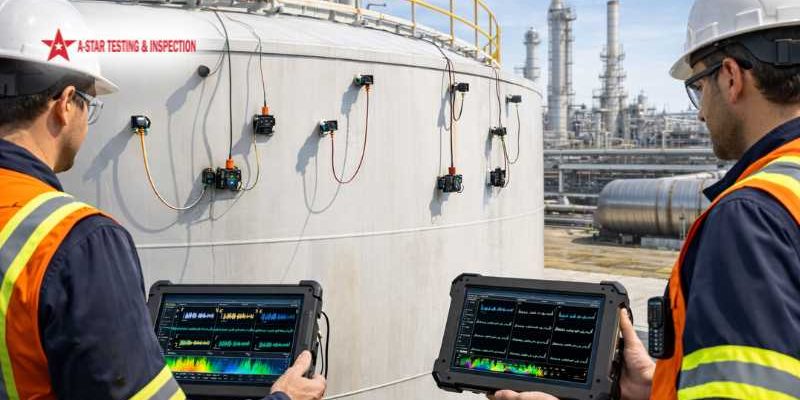
Storage tanks have hidden defects such as microscopic floor corrosion to hairline cracks, which can cause disastrous failures when undetected. That is why tank inspection acoustic emission testing ae services india are gaining relevance in the world of industries that are interested in detecting risks at an earlier stage but without compromising on operational efficiency. In the case of the oil, gas, and petrochemical industries in India, the integrity of large storage assets is a balancing act between safety and up-time issues that are high stakes.
A smarter way forward can be found with acoustic emission (AE) testing. AE is a live diagnostic tool; unlike a snapshot inspection of a shutdown, it can detect the stress waves emitted by active deterioration. This guide examines the reasons why AE testing services in India are the future of asset integrity management and how AE testing keeps the Indian industries on their toes.
What is Acoustic Emission Testing (AE)?
Acoustic Emission (AE) testing is a non-destructive testing method that is passive in nature. In contrast to ultrasonic testing, which is performed by sending the sound into a substance, AE listens to the sound that is already created in the substance when it is being strained.
When a defect (a crack or a corrosion pit) forms or expands, it emits a burst of energy in the form of transient elastic waves. Such stress waves run through the wall of the tank and are registered by very sensitive acoustic emission sensors.
Why AE Testing is Ideal for Tank Inspection
Operating efficiency is crucial in a competitive market like India. Acoustic emission testing tank inspection is ideal because:
- No Need for Shutdown: The main advantage is that inspections will be done when the tank is in service. The tank does not have to be emptied, cleaned, or gassed off.
- Real-Time Defect Detection: AE detects active defects. It differentiates between a harmless and stable blemish and a dangerous crack, which is growing.
- Global Coverage: Sensors mounted on the exterior of the tank are capable of tracking the whole structure, such as the floor, which is normally the hardest area to check.
How Acoustic Emission Testing Works
The acoustic emission inspection services are rather scientific and have a standardized workflow:
- Sensor Location: Piezoelectric sensors are carefully attached to the outside of the tank with magnetic storage devices or glue.
- Stress Application: The tank is monitored during a change in stress—usually a “fill cycle” where the increasing liquid level applies pressure to the floor and walls.
- Signal Detection: When the material is slightly deformed under load, active defects give off high-frequency stress waves.
- Triangulation: Since the system measures the time that a wave takes to reach various sensors, the system is able to identify the exact position of the defect with astounding precision.
Types of Defects Detected Using AE Testing
Professional AE testing services in India are committed to determining three critical points of failure that are critical:
- Cracks: Welds and heat-affected areas have incipient fatigue or heat corrosion cracking.
- Corrosion: Mapping “active” corrosion on the tank bottom floor, which is usually not visible by other NDT methods unless the tank is drained.
- Leaks: The distinctive high-frequency signal of the escape of a liquid or gas through a tiny puncture is determined.
Applications of AE Tank Inspection in Industries
The oil and gas tank inspection in India has never been more important than in this case, as India is pushing to increase its strategic petroleum reserves and refinery expansions.
- Refineries & Petrochemical Plants: Checking high-pressure spheres and atmospheric storage tanks in case of degradation by chemicals.
- Bulk Storage Terminals: The safety of the large-scale fuel depots of ports such as Mundra or Vizag.
- Chemical Manufacturing: Monitoring chemical tanks containing hazardous or corrosive chemicals that might leak into the second containment.
Benefits of AE Testing for Tank Inspection
Facility managers, by selecting tank inspection acoustic emission testing AE services India, will unlock a great ROI:
- Early Defect Detection: Repair defects at a micro level, not at a macro level of a break.
- Less Downtime: Removes the 2-4 weeks needed to clean the tank and do manual entry inspections.
- Structural Health Monitoring: This gives you a baseline of preventive maintenance, so you can prioritize repairs on the tanks that require them.
AE Testing vs. Other Tank Inspection Methods
| Feature | Acoustic Emission (AE) | Ultrasonic Testing (UT) |
| In-Service? | Yes, fully operational. | Frequently needs a part shutdown. |
| Cleaning? | No in-house cleaning required. | Requires clean surfaces/entry. |
| Coverage | 100% (Integral monitoring). | Spot checks or limited areas. |
| Defect Type | Active/Growing defects. | Existing/Passive defects. |
Although AE testing and ultrasonic testing are a popular debate, they are typically done concurrently: AE determines the location of the issue, and UT confirms the rest of the wall thickness within that particular location.
Choosing the Right AE Testing Service Provider in India
They adhere to Indian safety standards, including those of PESO (Petroleum and Explosives Safety Organisation) and OISD. In choosing an NDT inspection services India supplier, they must provide:
- Certified Professionals: Technicians ought to be certified by ASNT or PCN Level II/III in Acoustic Emission.
- High-end Technology: Multi-channel digital systems with the ability to remove the background industrial noise can be used.
- Local Knowledge: A supplier that comprehends the weather and business issues of the Indian industrial belt.
Select specialists to have a quality tank inspection.
Cost of AE Tank Inspection Services in India
The cost of AE testing in India is a risk mitigation investment. Although the initial daily rate of equipment and special technicians might be more than the simplest visual checks, the cost of the entire project is much less since you will not have to pay:
- Expenses of removing millions of liters of product.
- Cost of professional tank cleaning and waste disposal.
- Loss of revenue during the weeks the tank is out of service.
Why AE Testing is Critical for Asset Integrity
In the age of asset integrity management, data is king. AE testing provides the “digital pulse” of your storage assets. It not only complies with international safety codes (such as API 653), but also includes the documentation needed to pass the insurance and regulatory audit in India.
Conclusion: Smart Monitoring for Safer Storage Tanks
Tank inspection, acoustic emission testing, AE Services India is involved in the development of industrial safety. The operators are able to protect both the environment and their people by shifting to real-time acoustic emission testing in India, and this will not require them to sacrifice productivity. Nowadays, it is not a luxury to listen to your assets in 2026, but the most intelligent way to make sure that they can withstand the test of time.
Secure your tanks by applying state-of-the-art AE inspection services in India.
Frequently Asked Questions (FAQ)
Q1. Is it possible to detect corrosion on a tank floor using AE testing?
Ans: Yes. This is among the most typical applications of AE testing services in India. It picks up the high-frequency noise of the corrosion process and turbulence due to leaks.
Q2. Does the tank need to be full?
Ans: Normally, the tank should be filled at least 5075 percent. It is the pressure of the liquid that stresses the metal and any active defects to produce the acoustic signals that the sensors require.
Q3. Do refinery noises interfere with AE testing?
Ans: The modern systems employ higher-order software filters to cancel out the background mechanical noise of the nearby pumps or traffic, and only target the particular frequencies produced by structural defects.
Q4. What is the frequency of my AE survey?
Ans: Most Indian operators conduct an AE survey on a preventive maintenance schedule (typically at 3 to 5-year intervals) or more often when a tank is approaching the end of life.
For broader scope: for AE testing on pressure vessels, pipelines, reactors, and refinery assets beyond storage tanks, see our Acoustic Emission Testing (AE) Services in India page.
Explore our NDT services
Conventional NDT · Advanced NDT · Tank Inspection · Rope Access NDT · In-Service Inspection