One of the greatest threats to industrial property, pipelines, pressure vessels, storage tanks, and process equipment is corrosion. Unnoticed, it may cause structural failures, unplanned shutdowns, safety incidents, and expensive repairs. With industries becoming more concerned with reliability and risk-free operation, more sophisticated inspection techniques have become necessary to ensure that assets perform to their best.
Corrosion Mapping is one of the best methods to detect and evaluate the level of material degradation. This is a sophisticated inspection process that offers data on the depths of large-scale surfaces in more detail, and this process aids the owners of the assets in identifying corrosion, tracking the loss of walls, and making sound choices in terms of maintenance.
This guide discusses the functionality of corrosion mapping, its advantages, uses, and reasons why it is a very important part of current asset integrity programs.
What Is Corrosion Mapping?
Corrosion mapping is another type of non-destructive testing (NDT) that is applied to assess the integrity of metallic components through a wall thickness measurement in a designated region. In contrast to the traditional spot thickness measurements, corrosion mapping produces an overall graphic of material loss and corrosion distribution.
The method enables inspection teams to determine:
- Localized corrosion
- General wall thinning
- Pitting damage
- Erosion-related metal loss
- Patterns of internal and external corrosion.
An expert Corrosion Mapping service can assist companies in learning the real state of assets of critical value and prioritize the maintenance operations in a better way.
Why Corrosion Monitoring Is Important
Industrial assets are constantly subjected to environments that enhance degradation of the material, such as moisture, chemicals, high temperature, and environmental contaminants.
Unless properly monitored, corrosion may lead to:
- Equipment failures
- Product leakage
- Reduced operational efficiency
- Environmental incidents
- Increased maintenance costs
- Safety hazards
The proactive Corrosion Assessment and Monitoring programs enable companies to diagnose the problems before they escalate into a critical situation.
How Corrosion Mapping Works
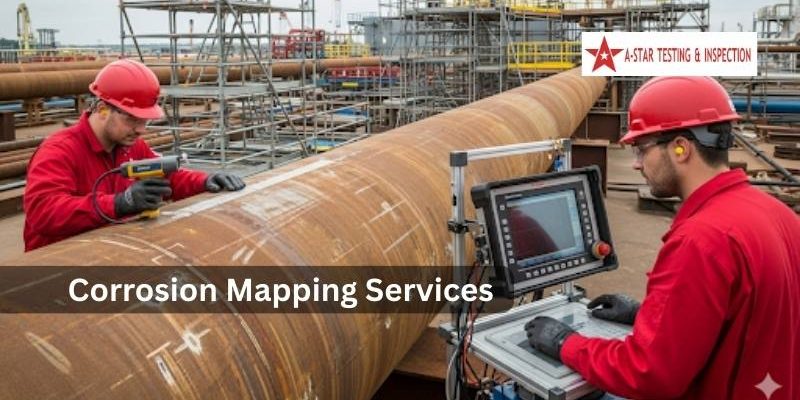
Corrosion mapping is normally carried out with the help of sophisticated ultrasonic inspection. The probe used in the inspection checks a surface and records thousands of readings of thickness on the surface under inspection.
Data collected is then translated into a thickness map in the form of colors indicating areas of concern.
Key Steps in the Process
Surface Preparation
The inspection area is washed to get the correct ultrasonic measurements.
Data Acquisition
Special scanners record the readings of the thickness across the area of choice.
Data Analysis
A comprehensive thickness profile with the severity and localization of corrosion is created by software.
Integrity Assessment
The results are analyzed by inspection specialists who may suggest corrective measures in case of need.
Such step-by-step analysis is much more informative than the conventional point-by-point checks.
Role of Ultrasonic Thickness Testing
Ultrasonic Thickness Testing (UTT) is one of the most common methods of corrosion evaluation.
UTT is a non-destructive method of measuring the material thickness using sound waves of high frequency.
Benefits of UTT
- Accurate thickness measurement
- Fast inspection process
- Non-invasive testing
- Appropriate in-service equipment.
- Reliable corrosion detection
Ultrasonic testing, when combined with mapping technology, provides very precise information on asset condition.
PAUT Inspection for Corrosion Mapping
Many organizations now use PAUT inspection for Corrosion Mapping to improve inspection accuracy and coverage.
Phased Array Ultrasonic Testing (PAUT) employs several ultrasonic elements that could be electronically manipulated to scan large regions efficiently.
Advantages of PAUT
Enhanced Coverage
The large inspection areas may be evaluated rapidly.
Improved Defect Detection
PAUT offers high-resolution data used in detecting corrosion and loss of the wall.
Detailed Imaging
The high-level imaging enhances the characterization of defects.
Better Maintenance Planning
Informed decision-making is achieved with thorough inspection data.
PAUT is now a favorite when it comes to critical assets where finer corrosion evaluation is needed.
Detecting Corrosion Under Insulation (CUI)
Corrosion that occurs under the insulation cover is one of the most problematic types of degradation.
What Is CUI?
Corrosion under insulation (CUI) inspection is aimed at identifying the corrosion which grows beneath thermal insulation on piping and equipment.
CUI may develop without being noticed until the loss of large amounts of metal.
Common causes include:
- Moisture ingress
- Damaged insulation
- Weather exposure
- Temperature cycling
Advanced inspection techniques enable detection of CUI without a significant amount of insulation removal.
Understanding Corrosion Under Pipe Supports (CUPS)
A second issue that is prevalent in industrial plants is corrosion that forms under pipe supports.
Why It Occurs
These areas are usually affected by the build-up of water, bad drainage, vibration, and coating damage, which contribute to the corrosion.
Professional corrosion under pipe support (CUPS) inspection services assist in the detection of concealed corrosion, which is possible before structural integrity is lost.
The aging piping systems and high-risk process environments are those subject to routine inspections.
Corrosion Mapping and Asset Integrity Management
The preservation of the state of the critical assets is one of the main goals of contemporary Asset Integrity Management programs.
Corrosion mapping assists integrity management by assisting organizations to:
- Identify high-risk areas
- Measuring corrosion rates.
- Extend equipment lifespan
- Reduce maintenance costs
- Improve inspection planning
- Enhance safety performance
Detailed corrosion data allows the operators to focus on repair based on the actual conditions of the asset instead of suppositions.
Industries That Benefit from Corrosion Mapping
Corrosion mapping is a common practice in any industry where metal corrosion may affect safety and performance.
Common Applications
Oil and Gas Facilities.
Pipelines, pressure vessels, separators, and process equipment.
Petrochemical Plants
Critical process system corrosion monitoring.
Power Generation
Boilers, condensers, and heat exchangers.
Marine and Offshore Assets
Structural elements that are in severe marine conditions.
Manufacturing Facilities
Storage tanks, piping networks, and production equipment.
The industries require the accuracy of Thickness Monitoring Inspection solutions to be credible and conform.
Emerging Trends in Corrosion Detection
The technologies of inspection are constantly developing, which allows for performing an assessment of assets more efficiently and accurately.
Industry Trends
- Automated ultrasonic scanning
- Corrosion mapping software.
- Drone-assisted inspections
- AI-driven defect analysis
- Predictive corrosion monitoring
- Risk-based inspection programs
Such innovations are enhancing the quality of inspections and minimizing operational inconveniences.
Frequently Asked Questions (FAQs)
Q1. What is corrosion mapping used for?
Ans: Corrosion mapping is applied to find wall thinning, pitting, and corrosion damage on large surfaces of industrial assets.
Q2. What is the difference between corrosion mapping and normal thickness testing?
Ans: The specific points are measured by standard thickness testing, whereas corrosion mapping gives a full-scale view of thickness differences throughout an area.
Q3. Is it possible to use corrosion mapping to detect corrosion under insulation?
Ans: Yes. High-tech inspection methods are used to detect the latent degradation when carrying out the corrosion under insulation inspections.
Q4. What are some industries that employ corrosion mapping?
Ans: Corrosion mapping services are usually employed in oil and gas, petrochemical, power generation, marine, offshore, and manufacturing industries.
Q5. Why is thickness monitoring important?
Ans: Thickness monitoring also assists in detecting loss of materials at an early stage before failures occur and enables organizations to plan efficiently for how to maintain the equipment.
Conclusion
With the aging of industrial assets and the harsh conditions they are exposed to, proactive management of corrosion has become critical in ensuring safety, reliability, and efficiency in the performance of assets. State-of-the-art inspection technologies give the finer details to detect degradation before it results in an expensive failure.
With Corrosion Mapping, organizations can enhance detection of corrosion, efficient maintenance planning, and maintenance life of important equipment. Together with ultrasonic testing, sophisticated monitoring schemes, and risk-based inspection plans, corrosion mapping can be considered one of the most useful tools that would assist in the corrosion performance and integrity of the assets on a long-term basis.
Explore our NDT services
Conventional NDT · Advanced NDT · Tank Inspection · Rope Access NDT · In-Service Inspection