The structural health of a vessel is the most critical asset in the global maritime industry. The Ultrasonic Thickness Gauging (UTM) to IACS Marine Vessels has become the standard of maintaining this health. Ships with aging experience the severe conditions of the marine environment that initiate corrosion, erosion, and metal fatigue. Such threats are invisible, and unless they are carefully monitored, they may cause disastrous structural collapse.
UTM enables ship owners and managers to comply with IACS, stay safe, and extend their fleet life significantly since it uses high-frequency sound waves to give a clear picture of the necessary thickness of the vessel parts in the ship, thereby promoting the safety and longevity of their fleet. This blog delves into the reasons why UTM is the foundation of the advanced marine NDT services and the concept of its role in the strict standards of the International Association of Classification Societies (IACS).
What Is Ultrasonic Thickness Gauging (UTM) for Marine Vessels?
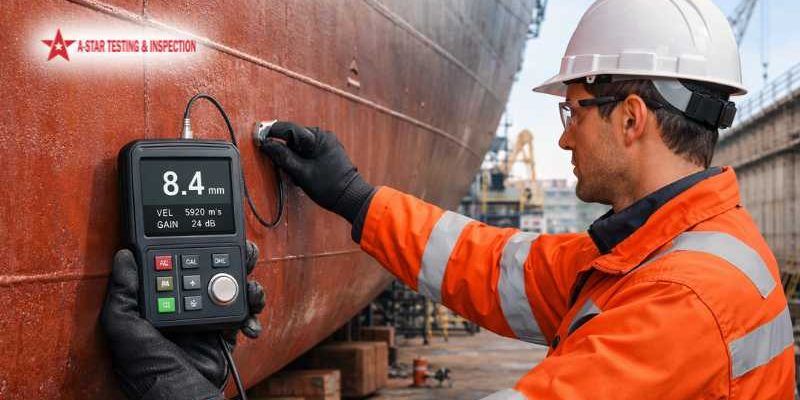
UTM is a non-destructive testing (NDT) technique that is specifically employed to determine the thickness remaining of a metal component. It operates by introducing an ultrasonic pulse into the material with the help of a transducer and recording the time taken by the pulse to bounce back off of the opposite surface.
In the case of IACS Marine Vessels, it is not only a safety check, but also a regulatory requirement. In contrast to conventional visual inspections methods, which can only reveal the surface rust, ultrasonic hull inspection enables the view of inside the metal and reveals the internal rust corrosion that cannot be seen so easily.
Core Components of UTM Inspection:
Ship Hull Inspection: The outer shell is monitored to check for localized or uniform corrosion.
Structural Steel Inspection: Inspection of bulkheads, transverse frame, and decks.
Corrosion Monitoring: Establishing a historical record of data to give an indication of when a plate will be in its lowest condition (when it needs a replacement).
The Importance of IACS Compliance in Marine Inspections
The International Association of Classification Societies (IACS) sets the technical requirements for designing, building, and service-life maintenance of the ships. In order to have an insured vessel that is eligible to sail, the vessel has to pass through regular periodical sailing surveys known as Class Surveys.
These surveys are required to contain the UTM of the ship hull (Intermediate and Special Surveys). A compliance inspection based on IACS will guarantee that:
- The vessel is aged and of a type that has a minimum thickness.
- The certified technicians record the data using calibrated equipment.
- Major societies (DNV, ABS, Lloyd’s Register, and RINA) accept the report format.
Key Benefits of UTM Inspection Services for Ships
Why is UTM more preferable to other types of testing? These advantages have an effect on safety and the bottom line.
1. Extreme Precision and Accuracy
UTM equipment today is able to measure thickness down to 0.01mm. Such detail is essential in fitness-for-service tests, which enable engineers to determine the hull plate structural strength that has been used.
2. Early Detection of Corrosion and Wear
Corrosion occurs frequently, either pitting or localized. UTM is able to detect these weak spots promptly so that preventive maintenance can be checked before a small spot of thinning becomes a breach of the hull.
3. Non-Destructive and Non-Intrusive
Since UTM does not need to touch both sides of the metal, it is possible to carry out in most scenarios without having to remove internal liners or coats. This saves the preparation labor expense and eliminates destructive protective paints.
4. Cost-Effective Asset Management
With an accurate understanding of the specific plates that are thinning, ship owners will be able to schedule steel renewals when the ship is in dry dock, undergoing ultrasonic testing instead of having to repair the ship in an emergency situation at sea.
How the UTM Inspection Process Works
To provide a quality structural integrity assessment of the ships, the technicians use a five-step process that is standardized:
Step 1: Surface Preparation
The section that is to be measured should not have loose scale, marine vegetation, or heavy rust. Although the modern version of through-coat technology enables the measurement of paint, the surface should be fairly smooth so as to provide an excellent acoustic bond.
Step 2: Couplant Application
Between the probe and the metal, a gel or liquid couplant is used. Ultrasonic waves travel poorly in air, and the couplant guarantees that the sound energy is introduced in the steel.
Step 3: Signal Emission and Echo Detection
The technician then slides the transducer over the bulkhead or hull. The device emits high-frequency waves that are reflected on the back wall. The thickness reading is obtained as a result of converting the time-of-flight immediately.
Step 4: Real-Time Monitoring and Logging
Measurements are done on certain grid points according to IACS regulations. Such digital records are kept so that they can compare to the data in past years.
Step 5: Analysis and Reporting
The last report identifies regions of “significant corrosion” (typically, 75% or more of the allowable diminution) and those areas needing immediate steel replacement.
Notable Operational Procedure: These UTM services are performed either in dry docks, on deck, or inside the compartments. There are no underwater or sub-sea inspection services. Hull gauging is done on all of the surface-accessible areas or when the vessel is not in the water.
Applications of UTM in the Marine Sector
UTM of IACS Marine Vessels is implemented in different critical areas:
- Bulkhead and Deck Inspection: This is necessary in bulk carriers and tankers, in which cargo may lead to internal abrasion and corrosion.
- Tank Testing: This is an evaluation of the thickness of ballast tanks, which are highly susceptible to oxidation by saltwater.
- Engine Room Structures: The integrity of foundations and heavy-load bearing frames is checked.
- Marine Vessel Maintenance Inspection: This is a regular inspection carried out during the journey or at the ports in advance of wear and tear.
Comparison: UTM vs. Other Marine Inspection Methods
| Feature | Visual Inspection | Magnetic Particle (MT) | UTM (Ultrasonic) |
| Detects Internal Thinning? | No | No | Yes |
| IACS Required? | Yes (General) | No (Specific cases only) | Yes (Mandatory) |
| Measurement Type | Subjective | Surface Flaws | Digital/Quantifiable |
| Downtime | Moderate | High | Low |
| Accuracy | N/A | High (for cracks) | Excellent (for thickness) |
The Rationale of Using Certified Professionals in UTM?
Thickness gauging does not produce all equal. To satisfy the inspection criteria of class society certification, you need to collaborate with a provider that provides:
- IACS-Recognized Technicians: Engineers who are trained in marine structures.
- Efficient Tools: Multi-echo or A-scan/B-scan gauges, which are capable of viewing thick coatings.
- Quality Management: Organizations that have a workflow that is compliant with ISO to guarantee the integrity of the data.
Frequently asked questions: Ultrasonic Thickness Gauging (UTM) of IACS Marine Vessels.
Q1: What is the frequency of IACS vessel inspection of UTM?
Ans: Typically, large UTM surveys are held every 5 years, when there is a Special Survey, and after every 2.5 years, when there is an Intermediate Survey. Nonetheless, monitoring in older (more than 15 years) vessels can be more frequent.
Q2: Does UTM operate with aluminum or composite hulls?
Ans: UTM is usually used on steel; however, it can be adjusted to aluminum. But, IACS standards of big commercial ships are mainly based on steel structures.
Q3: Is UTM able to detect cracks and also thickness?
Ans: Standard UTM is thickness. Ultrasonic Flaw Detection (UFD) or Phased Array (PAUT) is applied in order to detect cracks. The majority of professional marine NDT suppliers supply both.
Q4: Does the ship need to be relieved or changed to UTM?
Ans: Not necessarily. With the application of the Echo-to-Echo or Thru-Coat technology, we can get the thickness of the metal, but not the thickness of the paint.
Q5: Do you offer divers for hull thickness gauging?
Ans: No. We are all above-water and dry-dock services. We deal in surface-based structural integrity tests.
Conclusion
The structural integrity of a fleet is a huge undertaking that involves specificity, skills, and appropriate technology. The formulation of Ultrasonic Thickness Gauging (UTM) of IACS Marine Vessels offers evidence-based information to ensure a safe and efficient operation of the ships. It allows the shipping companies to be on the safe side of IACS standards and still not incur the huge costs associated with unexpected structural collapse by investing in good-quality UTM inspection services.
Is your vessel due for its Class Survey?
Do not take your structural integrity in your stride. Get in touch with A-Star Testing & Inspection to have IACS-compliant UTM services that focus on the accuracy of the services, safety, and prompt reporting.
Explore our NDT services
Conventional NDT · Advanced NDT · Tank Inspection · Rope Access NDT · In-Service Inspection