
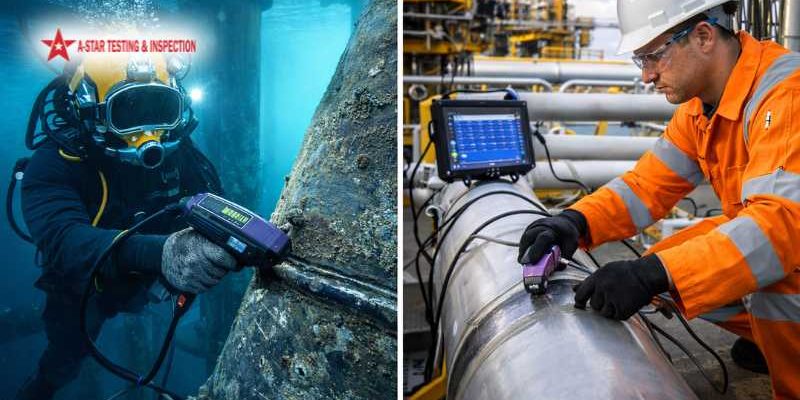
Surface cracks may cause critical failures when not detected. In the maritime and industrial industries, the soundness of a weld is at times concealed by a coating or hidden by the obscurity of the depths of the ocean. The conventional Non-Destructive Testing (NDT) techniques, including Magnetic Particle Inspection (MPI), tend to demand the total elimination of these finishes- a procedure that is not only lengthy, but it is also known to make projects expensive.
Alternating current field measurement (ACFM) inspection for underwater and above-ground applications has emerged as a revolutionary solution to these challenges. ACFM offers precise crack positioning and size detection above ground and underwater through the use of electromagnetic fields to aid in visualizing the coating and marine growth. This guide will discuss why ACFM will be the gold standard of asset integrity inspection in 2026.
What is an ACFM Inspection?
ACFM is a non-destructive testing (NDT) method of electromagnetic testing that is specifically intended to identify and quantify surface-breaking cracks in metallic parts. As opposed to simple eddy current testing, alternating current field measurement testing can accurately determine the length and depth of a crack.
ACFM is a non-destructive testing (NDT) technique of electromagnetic testing, developed with the specific purpose of detecting and measuring the surface-breaking cracks in metal components. Compared to the simple eddy current testing, alternating current field measurement testing can precisely estimate the length and depth of a crack.
How ACFM Inspection Works
The technology of ACFM is based on the physics of electromagnetic fields.
- Induction: A uniform alternating current is induced on the surface of the metal.
- Field Disturbance: When the current encounters a crack in the surface, it will be forced to go around and under the defect.
- Signal Variation: This diversion causes disturbances in the magnetic field above the surface.
- Measurement: Specialized sensors in the ACFM probe measure these disturbances. The length of the crack is indicated by the signal of $Bx$, and the depth of the crack is determined by using the signal of Bz.
With the help of these signals, the electromagnetic NDT testing technician will be in a position to know the amount of flaw seriousness without ever scraping a millimeter of paint.
Why ACFM is Ideal for Underwater and Above-Ground Inspection
ACFM is a dual-threat tool, which is versatile in contemporary maintenance:
Above-Ground ACFM Testing
ACFM is applied onshore to the structural integrity inspection of bridges, storage tanks, and refinery piping. It can penetrate up to 5mm of coating, which implies that it can be used to fireproof or apply anti-corrosive paint, which will not be destroyed during the audit.
Underwater ACFM Inspection
Subsea, ACFM is a game-changer. Marine structure inspection can be carried out by divers or ROVs, without the need to undergo the white metal cleaning necessary to carry out MPI. This minimizes diver bottom-time and goes a long way to minimize the chances of the environment being contaminated through cleaning waste.
Applications of ACFM Inspection
This technology is in high demand:
- Offshore Platforms: Inspection of jackets and welded joints of critical nodes.
- Ship Hulls: Fatigue cracks in rudders, propellers, and structural frames are detected.
- Pipeline Weld Inspection: High-pressure line stress corrosion cracking (SCC) monitoring.
- Industrial Infrastructure: Auditing crane rails, bridges, and theme park rides where safety is of utmost importance.
- Keywords: inspection of offshore oil and gas, inspection of marine structures.
Types of Defects Detected by ACFM
ACFM is specifically tuned for surface-breaking crack detection, including:
- Fatigue Cracks: These cracks are common in structures that experience cyclic loading (waves or vibrations).
- Weld Defects: Toe cracks and throat cracks in assembled welds.
- Stress Corrosion Cracking: Discovering localized corrosion-induced cracking in stainless steels.
Benefits of ACFM Inspection
ACFM inspection services are ROI based on safety and speed:
- Precise Crack Sizing: It not only locates the crack, but it measures its depth to enable engineers to make wise choices of repairing or replacing.
- Less Downtime: Removes the days of surface preparation and re-coating.
- None Coating Removal: Keeps the asset intact in terms of its protection throughout the inspection.
- Digital Audit Trail: Each scan is documented in a digital format, giving a verifiable record of the health of the asset.
Choosing the Right ACFM Inspection Service Provider
In choosing an NDT inspection company, they must comply with the following 2026 standards:
- Certified Technicians: Operators have to be CSWIP or PCN Level II/III certified in ACFM.
- State-of-the-Art Equipment: They ought to operate with the most advanced generation of multi-element probes in order to cover faster.
- Offshore Experience: In the case of subsea work, the ACFM service provider should have an established history of diver-held or ROV-integrated operations.
Select qualified personnel for crack detection.
Cost of ACFM Inspection Services
ACFM inspection cost is normally calculated based on the complexity of the environment and the surface area. Although the daily rate of the ACFM crew is greater than that of the MPI crew, the cost per weld is normally 30-50 percent less due to a 5 times faster inspection without the cleaning process.
Why ACFM is Critical for Asset Integrity
Predictive is the term in the age of asset integrity inspection. ACFM enables operators to observe the rate of crack development with time. With accurate knowledge of the depth of a fatigue crack, you can safely proceed with operations with a planned repair during the next scheduled shutdown, as opposed to an emergency closure.
Conclusion: Advanced Crack Detection for Safer Structures
Alternating current field measurement ACFM inspection for underwater and above ground is more than just a testing method; it is a strategic asset management tool. ACFM can make sure that structural safety is never compromised at the cost of operational performance by offering precise, real-time information via coatings and water. The first step to protecting your infrastructure in 2026 is the ability to see the invisible.
Professional ACFM inspection services can be guaranteed today to ensure structural safety.
Frequently asked questions (FAQ)
Q1. Is ACFM able to look through marine growth underwater?
Ans: Yes. Like a heavy crust should be removed, but ACFM can cut through light-moderate marine growth and all conventional marine coatings.
Q2. Can ACFM only be used on ferromagnetic materials?
Ans: Conventionally, yes, it is optimised on carbon steel. Non-ferromagnetic materials such as stainless steel and aluminum are, however, provided with probes in specialized ACFM inspection services.
Q3. What is the largest coating thickness of ACFM?
Ans: Coatings of up to 5mm are usually used to get reliable results. More than that, the signal level becomes lower, which entails special high-power probes.
Q4. What is the reporting of the data?
Ans: Technicians will give you a Butterfly Plot, a graphical display of the $Bx$ and $Bz$ signals that is a fingerprint of the crack, and can be added to your report on industrial inspection services.
Explore our NDT services
Conventional NDT · Advanced NDT · Tank Inspection · Rope Access NDT · In-Service Inspection