
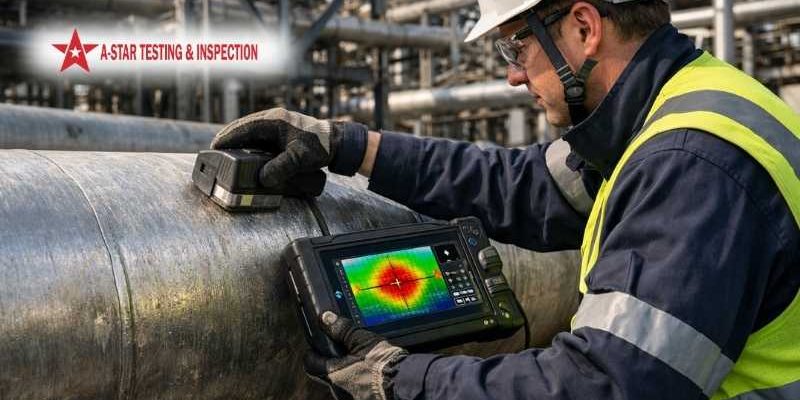
Corrosion under insulation (CUI) has been termed the silent killer of the industrial infrastructure. Since it is under thermal cladding and fireproofing, one cannot see it with the naked eye until there is a catastrophic leakage or a burst of a pipe. Previously, the available method of ensuring the integrity of pipes was to peel away miles of costly insulation, a labor-intensive, costly, and environmentally disturbing process.
Pulsed Eddy Current (PEC) of Insulated Pipes Services has broken the game. This developed non-destructive testing (NDT) method enables the measurement of the wall-thickness and detection of subsurface corrosion by several inches of insulation and weather jackets. With PEC in use, industries are now able to observe their most important piping items in real life, and at the same time keep safety and compliance without the need to touch the insulation.
What is Pulsed Eddy Current (PEC) Testing?
Pulsed Eddy Current (PEC) is an electromagnetic inspection method optimized to measure the thickness of steel components of non-conductive coatings or insulation materials.
In contrast to other testing methods, such as conventional eddy current testing, which involves a continuous wave, PEC involves the use of a pulsed magnetic field. This enables the signal to go a long way deeper through the base metal, even through:
- Thermal Insulation: Rockwool, calcium silicate, or polyurethane foam.
- Protective Cladding: Stainless steel, aluminum, or galvanized jackets.
- Fireproofing: Dense cementitious applied coverings.
- Marine Growth: Buildings on offshore assets.
The PEC is the best choice to use in the inspection of corrosion under insulation (CUI) in the high stakes industrial sites.
How PEC Inspection Works: The Science of Certainty
- Electromagnetic Pulse Generation: A dedicated PEC probe is attached to the outside of the insulation jacket. It produces a low-frequency electromagnetic pulse.
- Magnetic Field Penetration: The pulse establishes currents in the steel wall of the pipe under the insulation known as eddy currents.
- Signal Decay Measurement: On switching off the pulse, the eddy currents decay. This decay is directly proportional to the thickness of the metal.
- Data Interpretation: A thick wall of pipes will be less decay rate, and a thinner, corroded wall will be more decay rate.
- Reporting: The system will give a depth of relative wall thickness, which will enable the inspector to identify the precise locations where metal has been lost.
Key Applications of Pulsed Eddy Current (PEC) for Insulated Pipe Services
PEC technology offers a flexible solution to complex geometries, whether it is the large networks of refinery piping or the huge vertical bodies of storage tanks. The main industrial applications of PEC are the most effective and have the greatest impact, as listed below:
1. Oil & Gas Pipeline Inspection
Insulated pipelines are extremely vulnerable to joints and support ingression of moisture. PEC is a non-invasive method of screening CUI whereby the production process is not halted to conform to the API 570 piping inspection code.
2. Refinery and Petrochemical Plants
At refineries, the high-temperature lines are used, and the removal of insulation is a significant safety risk. PEC is capable of in-service inspection: inside and outside wall thinning can be detected when the pipes are hot.
3. Power Plant Piping Inspection
Power plants use lines of high-pressure steam. PEC guarantees that wall thinning in these essential circuits is detected early enough to comply with ASME standards of inspecting pipes and averting the occurrence of unexpected downtimes.
4. Offshore & Industrial Facilities
In offshore platforms, CUI is always a menace as a result of saltwater spray. PEC services screen jacketed piping and vessel skirt areas very quickly in hard-to-access locations using traditional NDT techniques.
The Strategic Benefits of PEC Inspection
Why are international asset managers changing to Pulsed Eddy Current (PEC)- Insulated Pipes Services? The advantages are clear:
- No Insulation Removal: Save 50-70 percent of the overall cost of inspection by leaving out the process of stripping, disposal, and replacement of insulation.
- In-Service Inspection: No plant shutdown is required. PEC functions by the cladding of the hot and pressurized system.
- Rapid Large-Area Screening: The PEC probes are able to scan large areas of piping within a short period of time and mark areas of concern that are to be investigated further.
- Safety & Compliance: Reduce employee exposure to high-temperature surfaces and dangerous materials (e.g., old asbestos insulation).
- Digital Traceability: Any scan will generate digital data that can be utilized in the management of long-term asset integrity, as well as trend analysis.
Standards and Compliance
Our PEC services are undertaken by qualified specialists as per:
- API 570: For the in-service inspection and repair of piping systems.
- ASME Section V: Governing the procedures for electromagnetic examination.
- ISO Certified NDT Protocols: Ensuring high-quality, repeatable data across every project.
FAQs: Pulsed Eddy Current (PEC) for Insulated Pipes Services
Q1: Is PEC able to distinguish between external and internal corrosion?
Ans: PEC is used to measure the overall thickness of the wall between the probe and the pipe. Although it is not always able to indicate on which side the corrosion is located, it is quite accurate in determining the total amount of metal loss, which is the most important factor from a safety standpoint.
Q2: How thick an insulation PEC can scan?
Ans: With the probe and pipe material, PEC may scan through insulation and cladding layers of up to 10 inches (250mm) deep.
Q3: Is PEC a substitute for Ultrasonic Testing (UT)?
Ans: PEC is a good screening tool used to detect thin areas quickly. Following PEC identification of a hot-spot, UT (with localized insulation removal) can be applied to make a point-specific and absolute measurement.
Q4: Does PEC have the potential to work on stainless steel cladding?
Ans: Yes. Although the cladding is conductive, PEC software is programmed to ignore the thin cladding and instead target the carbon steel pipe underneath.
Conclusion
PEC Insulated Pipes Services is a radical solution to the contemporary world of industry. PEC enables companies to identify the existence of corrosion early, minimise maintenance expenses, and avert environmental catastrophes by offering a window using insulation.
PEC is the most effective means of ensuring there is operational stability and structural integrity in an age where infrastructure is old, and the regulatory scanners are becoming more and more serious.
To find out how our PEC experts can assist you in getting rid of the dangers of Corrosion Under Insulation (CUI) without the expense of removing the insulation on your pipes, get in touch with A-Star Testing and Inspection Today.
Related Services
For active-defect monitoring of insulated assets and tanks alongside PEC screening, see our Acoustic Emission Testing India service. AE detects active corrosion, leaks, and crack growth in real time during in-service load cycles.
Explore our NDT services
Conventional NDT · Advanced NDT · Tank Inspection · Rope Access NDT · In-Service Inspection