The maintenance of the structural integrity of pipelines, pressure vessels, and storage tanks is a crucial concern in the contemporary industrialized world. Failures of a single weld or an unnoticed area of corrosion can cause disastrous effects on the environment and fiscal implications in the oil and gas, petrochemical, and power generation sectors.
PAUT ToFD Pipe, Pressure Vessel, and Tank Inspection has become the international standard of volumetric inspection. The industries can have 100% inspection coverage by the combination of the fast scanning of Phased Array Ultrasonic testing (PAUT) with the accuracy of Time of Flight Diffraction (ToFD) in terms of crack sizing. The innovative, non-invasive solutions, which are more advanced, take the place of traditional radiography, providing a faster alternative without the dangers of radiation.
What Are PAUT & ToFD Inspections?
In order to appreciate the strength of this combined strategy, it is necessary to consider how these two different ultrasonic technologies can be used to complement each other.
Phased Array Ultrasonic Testing (PAUT)
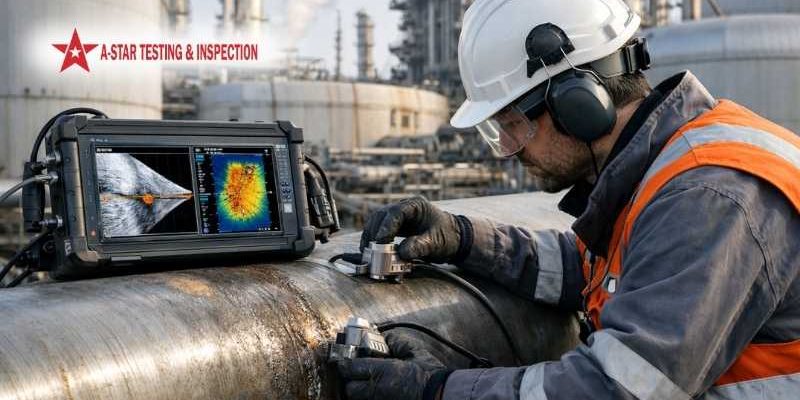
PAUT employs a probe that has several tiny ultrasonic elements (typically 16 to 128). These are electronically pulsed and switched in and out at various times to steer, focus, and sweep the beam through the material.
- High-Resolution Imaging: Generates a color-coded S-scan or C-scan of the material.
- Multipurpose: Can be used when dealing with complicated geometries and finer corrosion maps.
Time of Flight Diffraction (ToFD)
ToFD operates by diffracting sound waves on the ends of a fault, the location, and the size of the fault. Whereas PAUT is ideal in the detection of defects, ToFD is the industry leader in the sizing of defects.
- Superior Precision: It is superb in the determination of the height and length of cracks.
- Volumetric Coverage: This is a type that monitors the volume of a weld in one pass.
Key Applications of PAUT & ToFD
A combination of these technologies makes dedicated use possible in several high-risk environments:
1. Pipeline Inspection
Girth and internal corrosion of pipelines are likely to occur. PAUT ToFD Pipe, Pressure Vessel, and Tank Inspection is an automated weld evaluation and high-speed corrosion mapping to ensure the API standards are adhered to and save the time spent in the ditch.
2. Pressure Vessel Integrity Testing
Welding in high-pressure conditions cannot tolerate any defects in welding. PAUT identifies porosity and absence of fusion, whereas ToFD allows any cracks that are detected to be sized with less than millimeter precision to comply with ASME standards.
3. Industrial Storage Tank Inspections
The biggest tanks are susceptible to pitting, slenderness, and floor corrosion. This dual-ultrasonic system enables the use of a non-invasive imaging technique of tank shells and floors, which yields the high-resolution data required in Fitness-for-Service (FFS) assessments.
4. Refinery and Power Plant Equipment
Boilers, heat exchangers, and heavy-wall reactors require periodic “turnaround” inspections. Automated scanners equipped with PAUT and ToFD can navigate these assets quickly, identifying critical defects before they lead to a forced outage.
The Strategic Benefits of Combined Ultrasonic Testing
- 100% Volumetric Coverage: These methods are applied in contrast to spot-checking so that 100% of the weld or plate is covered.
- Superior Defect Sizing: ToFD avoids the pilot error in defect height, excluding guesswork that is vital in determining the remaining life of the assets.
- No Radiation Risk: There is no need to clear the area or halt work environment around, like in Industrial Radiography (RT), and it means that no one has to work much on downtime.
- Digital Traceability: Each scan is stored in the form of a digital file, which forms a permanent and auditable record that is useful in the long-term management of the integrity of the assets.
- Fast Results: Available data. Great to know immediately whether a weld is accepted or rejected without having to wait until the film develops.
The Inspection Process: Precision in Motion
- Surface Preparation: The preparation of the surface is accomplished so as to give the best ultrasonic contact.
- Probe Set up: 2 PAUT and ToFD probes are fixed to a semi-automated crawler or a manual crawler.
- Data Acquisition: The system is moving the scanner along the weld or the pipe, and a volumetric map of the inside is captured.
- Analysis & Interpretation: Certified Level II or III technicians analyze the ultrasonic “A-scans,” “B-scans,” and “D-scans” to identify anomalies.
- Final Reporting: It is very detailed, and a report is produced with high-resolution images of the parts and with clear advice on whether it should be repaired or not.
Standards and Compliance
Our services are conducted by certified specialists in accordance with the world’s most rigorous engineering codes:
- ASME Section V: Governing non-destructive examination.
- API 510, 570, & 653: For the inspection of vessels, piping, and tanks.
- ISO Certified Protocols: Ensuring high-quality, repeatable results across every project.
Frequently asked questions: PAUT and ToFD as Pipe, Pressure Vessel, and Tank Inspection.
Q1: PAUT/ToFD a valid replacement of Radiography (RT)?
Ans: Yes. Indeed, additional current codes (such as ASME Section VIII) have shifted towards PAUT/ToFD due to its more precise volumetric sizing and lack of radiation safety hazards.
Q2: Is it possible to identify corrosion using coatings with these methods?
Ans: Yes. State-of-the-art ultrasonic probes are able to penetrate even some forms of protective coating, offering an accurate measure of wall thickness without stripping the surface.
Q3: How rapid is the inspection relative to standard UT?
Ans: PAUT is also much faster due to the electronic steering of the beam. One scan is able to scan the same area that would require a manual UT technician to scan dozens of individual probes.
Q4: Are these services accompanied by underwater checks?
Ans: No. Pipe, Pressure Vessel, and Tank Inspection: PAUT and ToFD are still limited only to above-ground facilities and onshore.
Conclusion: Total Asset Assurance
PAUT and ToFD of Pipe, pressure vessels, and tank Inspection is the ultimate solution to modern day industrial security. Combining the speed of the phased array technology combined with the accuracy of the diffraction, the industries would be provided with an unprecedented view of the structural health of their most important resources.
It is the safest and most efficient method of NDT in the world, where the main factors that make the difference are safety and efficiency.
Call A-Star Testing & Inspection Today to find out how our PAUT and ToFD experts can streamline your next inspection and give complete asset security.
Explore our NDT services
Conventional NDT · Advanced NDT · Tank Inspection · Rope Access NDT · In-Service Inspection