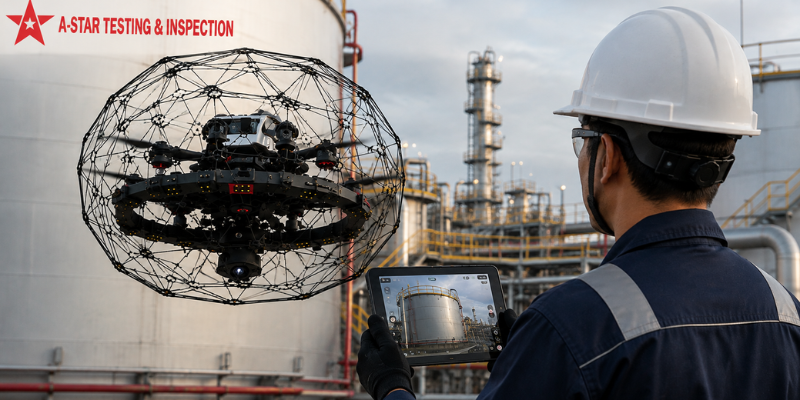
The use of unmanned aerial vehicles (UAVs) is making industrial inspection quicker, safer, and more data-driven. The inspection of hard to access structures, like pipelines, storage tanks, chimneys, towers, bridges, offshore platforms, refineries, and large industrial facilities, are also being undertaken using drone services in India. With high-resolution cameras, thermal sensors, and other inspection technologies, drones will be able to gather valuable visual data without the need to erect a lot of scaffolding or long shutdowns.
In industries where access, height, distance, or risky conditions prevent traditional inspection methods, drone technology offers a feasible approach to gathering inspection information and minimizing exposure to unnecessary hazards.
What Are Industrial Drone Inspection Services?
Drone inspection is the application of remotely controlled or autonomous UAVs with cameras and special sensors to take pictures and videos of industrial property. The data obtained is then examined by skilled inspection officers in order to detect any observable faults, wear and tear, or places which may need additional scrutiny.
Drone Inspection Services may be implemented to provide both regular inspections and specific inspection programs. A drone can have high-resolution optical cameras, thermal sensors, zoom cameras, or other sensors depending on the asset and the aim of the inspection.
The technology fails to substitute all of the traditional NDT techniques. Rather, it can be used to supplement methods like Ultrasonic Testing (UT), Magnetic Particle Testing (MT), Liquid Penetrant Testing (PT), and Radiographic Testing (RT).
How Does Drone-Based Industrial Inspection Work?
The common Drone-Based Industrial Inspection would start with outlining the scope of inspection and revealing the areas of the asset that should be inspected. The inspection crew considers the conditions of access, environmental conditions, the geometry of assets, and operational requirements and then plans the flight.
The UAV subsequently proceeds to a pre-defined flight plan around the building, taking photos and video. Areas that can be captured by high-resolution cameras include weld zones, structural members, pipe supports, tank roofs, elevated platforms and other areas that are hard to access.
Following data collection, inspection staff examine the images and videos to identify visible conditions, like corrosion, coating wear, cracks, deformation, signs of leaks, damaged insulation, loose elements, or structural deformities. The results can then be recorded in an inspection report to make use of when planning maintenance and investigating further.
Major Applications of Industrial Drone Inspection
Oil and Gas Facilities
Oil and gas plants are filled with elaborate systems of pipelines, tanks, towers, flare stacks, and others. UAVs are able to offer visual access to high areas or areas that are hard to reach and reduce the use of traditional access setups.
Storage Tanks
The external visual inspection of tank roofs, shells, fittings, and surrounding structures can be done using drone technology. It is capable of detecting damage to coating, corrosion signs, deformation, and other expressible situations.
Pipelines and Pipe Racks
Long pipeline networks and high pipe racks may not be easily checked manually. UAVs are capable of obtaining finer visual data on large areas, and this information will assist inspection teams to identify areas which might need more attention.
Chimneys and Stacks
Industrial stacks and tall chimneys may need special access equipment to inspect them traditionally. Close visual data of external surfaces and cracks, corrosion, and coating can be provided through aerial imaging.
Marine and Offshore Structures
Aerial inspection can be applied to offshore platforms, ship structures, cranes, decks, and other marine assets since most of them are hard or unsafe to access manually.
Power Plants and Manufacturing Facilities
Manufacturing sites and power plants have many elevated buildings and structures. The UAV inspections are able to assist in routine condition monitoring and also assist in guiding the maintenance group on areas in need of closer evaluation.
Benefits of UAV Inspection Services
Among the most significant benefits of UAV Inspection Services is enhanced access to hard-to-reach areas. In most inspection cases, drones are able to access high locations without the use of traditional scaffolding.
The other significant advantage is that it reduces inspection time. The ability to visually survey large structures can be more effective as inspection teams are able to gather information over a greater area in a shorter time.
Drones may also eliminate the necessity of personnel in high places to carry out inspections depending on the scope of inspection and conditions at the site. This can assist in minimizing exposure to some of the access hazards.
The digital photographs and videos will prove useful records that can be used to compare with the subsequent inspections. This makes a visual history of asset condition and can assist in planning maintenance and monitoring deterioration.
Drone Inspection vs Conventional Inspection
Conventional inspection techniques are still significant in a wide range of industries, especially where surface or internal inspection must be in detail. But drones can be used to offer an efficient first-level visual examination of large or inaccessible structures.
Traditional methods of inspection can involve the use of scaffolding, rope access, lifts, shutdowns, or other access systems. In some cases, drone technology can cut these requirements to allow appropriate visual inspection activities.
A combination of aerial visual inspection and proper NDT methods seems to be the most effective method. In case a drone detects a suspicious area, inspectors can do a specific ultrasonic thickness measurement, PAUT, radiography, or other appropriate test.
Technologies Used in Aerial Inspection Services
More than standard cameras can be used by Modern Aerial Inspection Services. Optical systems with high resolutions are applied when a visual inspection is required in detail, and thermal cameras may assist in detecting temperature changes that are related to specific equipment or a certain state of operations.
Zoom cameras ensure that the images are captured in detail and at a safe distance, and specialized software will be able to organize inspection photographs and videos and make them easier to analyze and report.
The proper technology varies according to the asset, purpose of inspection, environmental factors, the necessary resolution of the image, and procedures that can be used.
Important Considerations Before a Drone Inspection
The operation of a drone around an asset is not enough to conduct a successful industrial UAV inspection. The planning of flight needs to take into account weather, wind, visibility, nearby buildings, electromagnetic interference, restricted spaces, battery needs, and site-specific safety measures.
The scope of inspection must also specify what is to be inspected by the drone and what is an actionable finding. Drone operations must be in accordance with relevant Indian aviation regulations and site approvals where necessary.
Above all, inspection data must be deciphered by properly qualified personnel. A photograph will pinpoint a visible sign, but it may need more inspection or evaluation to identify its engineering worth.
Role of Drone Inspection in NDT and Asset Integrity
The use of drones to inspect assets is becoming a common aspect of current asset integrity programs. It offers a useful way to gather visual data that could be repeated and find places that should be scrutinised more closely.
In cases where organizations have to deal with numerous industrial assets, UAV inspection can be offered in combination with Non-Destructive Testing (NDT) to enhance the planning of the inspection. Drone surveys may also be used to detect potential problem areas, and follow-up conventional or advanced NDT techniques can be applied selectively.
This will be possible to minimize the need to conduct unproductive inspections and give the maintenance teams more valuable information to make decisions.
Frequently Asked Questions
Q1. What are drone inspection services used for?
Ans: The services of drone inspection are provided to explore hard-to-reach industrial equipment like tanks, pipelines, towers, chimneys, bridges, offshore structures, and high-elevation equipment in a visual way.
Q2. Will drones be able to substitute traditional NDT?
Ans: No. Drones are more likely to give visual and sensor information. Traditional and modern NDT technologies are necessary when internal defects, the material thickness, the integrity of the welds, or other particularities have to be discussed.
Q3. Can drones be used to inspect pipelines?
Ans: Yes. UAVs are able to scan the available external areas of pipelines and pipe racks to assist in the detection of visible corrosion, coating corrosion, mechanical damages, and other damages that might need additional investigation.
Q4. Which industries employ industrial drone inspection?
Ans: UAV technology can be applied by oil and gas, petrochemical, power generation, manufacturing, construction, marine, offshore, infrastructure, and energy companies to have appropriate inspection applications.
Q5. What does a drone inspection report entail?
Ans: A report can consist of inspection photographs, videos, observed items, assets locations, inspection dates, observations, and suggestions on further analysis or repairs depending on the project.
Conclusion
Drone technology will transform the process of visual inspection of industrial assets around India. Industrial Drone Inspection may offer quicker access to hard-to-reach areas, lessen the necessity of some traditional access setups, and produce advantageous digital inspection data. Nevertheless, it is most useful when the UAV surveys are combined with qualified inspection practices and the relevant NDT practices.
Drone services in India can constitute a significant component of a contemporary condition-monitoring and asset-integrity strategy of industrial organizations that are engaged in the management of pipelines, tanks, offshore structures, power facilities, and other important assets. A-Star Testing & Inspection has the potential to assist industrial inspection needs, integrating the necessary inspection technologies with qualified staff and project-specific inspection processes.
Related Services
Pressure Vessels and Storage Tanks