
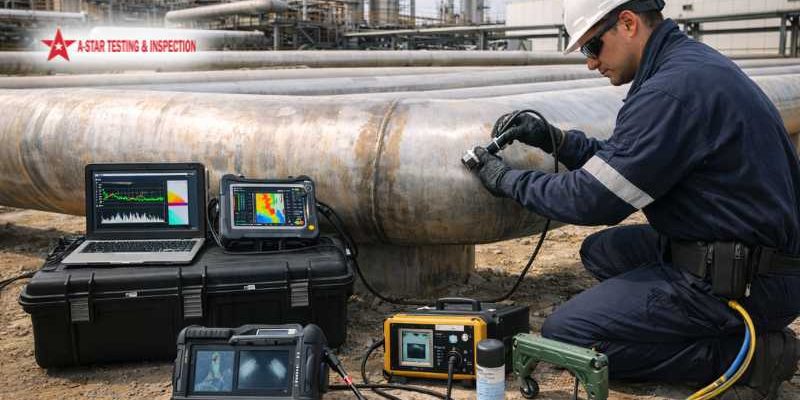
The components and structures of industries are constantly subjected to extreme loads, high-pressure conditions, corrosion, and mechanical degradation. In the oil and gas industry, particularly nuclear power, one bolt, weld, or a wall of a pipe can be damaged in an insidious way, resulting in disastrous outcomes. It is important to spot such flaws at a young age to prevent accidental downtime, ecological catastrophes, and serious safety issues.
A good example would be non-destructive testing services, a high-tech, reliable, and non-destructive method of detecting surface and internal defects without harming the material. This will enable 100 percent of an asset to be checked when it is still active and will guarantee its safety in the short term and performance in the long term.
What Are Non-Destructive Testing Services?
Non-destructive testing (NDT) is a term that encompasses a number of different inspection methods applied to assess the characteristics of a material, component, or system in such a way that they do not cause any type of permanent physical alteration. As opposed to destructive testing, where a sample is pulled, bent, or broken to determine its limit, NDT inspection services leave the asset in perfect condition.
An industrial infrastructure diagnostic physician is a professional in a non-destructive testing company. With the help of modern physics, which includes sound waves, electromagnetism, and radiation, technicians can look into solid steel and concrete and see through them, revealing cracks that can not be detected with the naked eye.
Types of Non-Destructive Testing Methods
In the present, the NDT toolkit will have developed further to become an advanced set of digital approaches. Both techniques are used in particular inspection requirements, depending on the material and the environment:
- UT: This is the use of high-frequency sound waves in order to measure the thickness of the wall and locate the internal cracks.
- Radiographic Testing (RT): X-rays or Gamma rays are used to produce a shadow image of the internal structure, like a medical X-ray.
- Magnetic Particle Testing (MT): This is very good in detecting cracks on the surface and on the edges that are less deep than the steel itself.
- Dye Penetrant Testing (PT): A very portable technique, based on colored dyes, to make the cracks visible on the surface.
- Eddy Current Testing (ET): A method of testing involving the utilization of electromagnetic induction in order to identify non-ferrous conductive materials, such as heat exchanger tubes with cracks.
- Phased Array Ultrasonic Testing (PAUT): A more modern form of UT where more than one beam is used to produce a slice of the material in three dimensions in real-time.
Why NDT Services Are Important for Industries
The worth of industrial NDT services extends way beyond mere maintenance; it is an important aspect of asset integrity management.
- Early Detection of defects: Early detection of fatigue cracks before they get out of hand and lead to rupture.
- Safety Assurance: The safety of the workers is ensured by making sure that the pressurized systems and structures that can carry weight are in good condition.
- Compliance: The strict requirements of international standards such as API, ASME, and ISO.
- Informed Maintenance: This is the provision of data required to make the decision whether you should repair a component or if it will be possible to operate it until the next planned shutdown.
Industries That Use NDT Services
The following services are a mission-critical need of high-stakes industries around the globe:
- Oil & Gas: Offering pipeline inspection services in order to ensure safe transportation of hydrocarbons over long distances.
- Power Generation: Auditing of steam turbines, boiler tubes, and nuclear reactor parts.
- Manufacturing: Production of high-precision parts in the aerospace and automotive industry.
- Construction & Infrastructure: Inspections of tunnels, skyscrapers, and bridges to ascertain whether they contain a concrete void or corrosion of the steel.
- Keywords: inspection services of refineries, subsea NDT, aerospace testing.
Benefits of Non-Destructive Testing Services
The payback of using professional industrial inspection services cannot be denied:
- High Accuracy: Present-day digital sensors are able to detect defects in microns.
- Cost Savings: The savings in cost that can accrue when one emergency shutdown is prevented are in the millions of dollars of lost production.
- Minimal Disruption: NDT can be conducted with most being done when the plant is live, thus there is no need to halt operations to conduct an audit.
- Asset Longevity: With localized corrosion, you can increase an asset’s life by decades, through detection and treatment.
NDT vs Destructive Testing
The basic distinction is in the maintenance of the property. In destructive tests, you destroy a part to know how it breaks. When used in NDT testing services, you acquire that knowledge when the part is still functioning. Destructive testing is just not possible with expensive or critical infrastructure, such as a $500 million offshore platform. NDT makes it possible to continuously observe the actual asset in the real-life setup, which gives a lot more useful information in their safety evaluations.
Safety and Compliance in NDT Inspection
The end result of all third-party inspection services is integrity. NTD should adhere to a high level of industrial compliance in order to make the data reliable:
- Certified Staff: Technicians are to be of Level II or Level III qualification (ISO 9712 or ASNT).
- Calibrated Hardware: Sensors and probes should be periodically checked against “master samples” to verify that they have not drifted.
- Comprehensive Reporting: Each and every inspection should be followed by a digitally signed report that contains the raw data, the interpretation, and the signature of the technician.
How to Choose the Right NDT Service Provider
The choice of an inspection company is a move that will affect the safety of your facility.
- Technological Maturity: Do they have legacy film radiography or modern, safer digital radiography?
- Prior experience in the industry: Does the NDT service provider have any particular experience in your industry (e.g., subsea vs. aerospace)?
- Data Portability: Does it give reports in a format that would be compatible with your current Asset Management Software?
Select specialists to get reliable non-destructive testing services.
Cost of Non-Destructive Testing Services
The price of the NDT service is usually set based on the complexity of the procedure applied and the availability of the location (e.g., requires rope access or scaffolding). Although specialized techniques such as PAUT or Radiography have a greater daily rate, they can be cheaper as they can give results much quicker than manual techniques.
Tip: NDT is an insurance policy to invest in quality. An inspection cost is a small part of a disastrous material failure.
Future Trends in NDT Technology
The sphere of high-tech NDT technology is quickly acquiring a tendency towards automation:
- Digital Radiography (DR): There is an instant, filmless X-ray with much less risk of radiation.
- Robotic Crawlers & Drones: Examination of high-rise chimneys or inside tank floors without exposing humans to a small area.
- AI and Machine Learning: These algorithms have the capability of scanning thousands of ultrasonic signals to indicate the presence of anomalies to the technician and thus, minimizing human fatigue.
Conclusion: Ensure Safety with Advanced NDT Services
The non-destructive testing services are important in ensuring safety, and identification of defects, as well as compliance in the industry operations. With the increased complexity of infrastructure and the tightening of safety standards, the importance of high-precision NDT will continue to rise. With the help of selecting an appropriate service provider and testing methodology, the businesses will be able to enhance their reliability, safeguard their workforce, and make their assets work at optimum efficiency in the future.
Get in touch with us today in order to receive professional non-destructive testing.
Frequently Asked Questions (FAQ)
Q1. Is NDT totally safe on the asset?
Ans: Yes. Definitely, NDT does not modify the physical or chemical characteristics of the material. The risk of damage in the course of a typical inspection is zero.
Q2. What is the average duration of NDT inspection?
Ans: It depends on the technique. A basic Dye Penetrant test may require 30 minutes, whereas a complete Phased Array inspection of a complicated pipeline weld can require a number of hours of data analysis and scanning.
Q3. Which is the best method of NDT?
Ans: Accuracy is a question of what you seek. Phased Array UT is very precise in internal volumetric defects, whereas Magnetic Particle Testing is the one that is used in gold standard for surface-breaking cracks in steel.
Q4. Is it possible to perform NDT on hot pipes?
Ans: Yes. NTD can be conducted on live assets up to temperatures of 350 C or more with the help of special probes and so-called hot couplants.
Related NDT Services
Conventional NDT · Advanced NDT · All NDT Services
Frequently Asked Questions
What is Non-Destructive Testing (NDT)?
NDT is a group of inspection techniques - UT, RT, MT, PT, ECT and others - that check the integrity of welds, plates, pipes and components without damaging them, so equipment can stay in service.
Which NDT methods does A-Star provide?
A-Star delivers conventional NDT (UT, RT, MT, PT, VT) and advanced NDT (PAUT, ToFD, ECT, LRUT, PEC, corrosion mapping) plus tank, rig, rope-access, underwater and marine/offshore inspection across India.
Is A-Star an accredited NDT company?
Yes - A-Star Testing is an established NDT and inspection company with certified Level II/III technicians working to international codes (ASME, API, ASTM, ISO).