
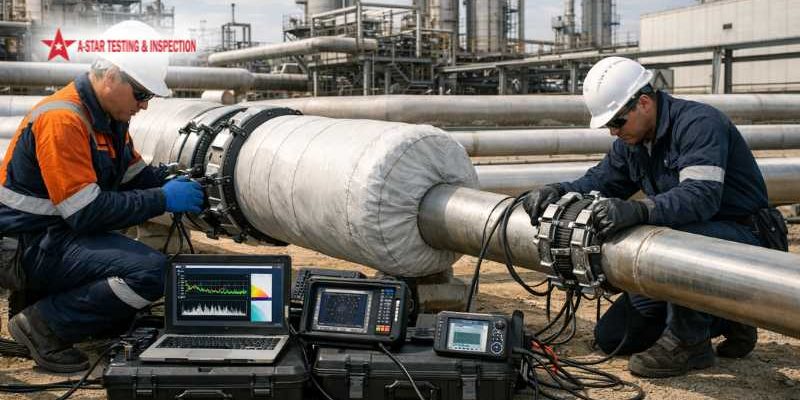
The pipelines and industrial structures may undergo corrosion and material degradation that may cause severe failures when not detected early. In other industrial uses, such as petrochemicals and power generation, miles of piping may be covered by insulation, soil, or elaborate structural supports. Conventional inspection techniques are usually very demanding in terms of accessibility, costly scaffolding, and considerable idle time to perform a simple inspection. Long range UT (LRUT) and short range UT (SRUT) services are the latest form of ultrasonic services that can be used to detect corrosion, gauge wall thickness, and guarantee asset integrity with minimum disruption.
With the broad-area search and verification capabilities of LRUT and the precision of surgical capability of SRUT, asset managers can adopt an integrated search and verification strategy. Not only does this method determine the possible locations of potential hotspots over kilometers of infrastructure, but it also gives the detailed information required to make decisions regarding repairing or replacing the infrastructure.
What is Ultrasonic Testing (UT)?
Ultrasonic testing (UT) is a form of non-destructive testing (NDT) that employs sound waves of high frequency to determine internal defects and gauge the thickness of materials. Ultrasonic testing services can detect defects like cracks, voids, and thin walls without damaging the part by injecting ultrasonic pulses into a substance and by timing how long it takes the sound to bounce back.
Being one of the foundations of the non-destructive testing UT methods, the technology is extensively applied in the inspection of pipelines, tanks, and structural elements. UT today has become more than just a basic handheld probe, into sophisticated, automated devices that can see the inside of a metal object and determine its internal health in 3D.
What is Long Range UT (LRUT)?
Guided wave ultrasonic testing (Long Range Ultrasonic Testing (LRUT)) involves testing long lengths of pipelines at a single and stationary point. LRUT employs a ring of transducers clamped around the pipe to transmit low-frequency ultrasonic waves dozens of meters in each direction, unlike traditional UT, which only checks the spot right beneath the probe.
This renders it the best instrument to use on long-range ultrasonic testing pipeline projects where access is limited. It has specifically been used in the process of identifying corrosion under insulation (CUI), the examination of road crossings, and the auditing of buried piping without requiring large-scale excavation. In one LRUT shot, more than 50 meters of pipe can be screened, and parts of the pipe where metal has been lost that demand further study can be found.
What is Short Range UT (SRUT)?
Short Range Ultrasonic Testing (SRUT) is a localized testing that is used to measure the thickness and detect defects. Whereas LRUT is the scout that determines the general whereabouts of a problem, SRUT is the microscope. It is normally employed in the examination of the initial several meters of a pipe or to confirm certain regions outlined by an LRUT check.
Short range ultrasonic thickness testing is very useful in the examination of dead zones, where other examination techniques prove ineffective, like at the point where a pipe joins to a concrete wall or a supporting saddle. SRUT guarantees that the engineers get the necessary data to determine the remaining life of the asset by giving a high-resolution map of the wall thickness measurement using UT.
LRUT vs SRUT: Key Differences
The distinction between LRUT and SRUT lies mostly in the scale and resolution:
| Main Objective | Quick screening/Searching. | Detailed verification/Sizing. |
| Coverage | To 100 meters on a site. | Localized 1-3 meters. |
| Sensitivity | Losses metal > 35-percent of cross-section. | The presence of microscopic pitting and thinning is detected. |
| Best Use Case | Case Pipe Insulation / Buried Pipes. | Tank floors, pipe supports, and concrete entries. |
Through the combination of both, an NDT inspection provider is able to provide a 100% coverage guarantee that is time-saving and technically demanding.
Why LRUT & SRUT Are Critical for Asset Integrity
Structural integrity inspection is an ongoing need, especially in the ageing infrastructure.
- Corrosion Detection Ultrasonic Testing: Before a breach occurs, internal and external corrosion can be detected.
- Metal Loss Detection: This is a measurement of the amount of metal that is actually removed from a wall of a pipe.
- Risk Mitigation: This is avoiding disastrous failures that may cause environmental disasters or loss of life.
- Regulatory Compliance: Adherence to the rigorous audit standards of ASME, API, and the local safety authorities.
Applications of LRUT & SRUT Services
Such services are high conversion needs of these key industrial industries:
- Oil & Gas Pipelines: Providing pipeline inspection services on cross-country lines and refinery tie-ins.
- Refineries: Checking piping and overhead lines during turnarounds that have high temperatures.
- Storage Tanks: SRUT is used to check the important part of the tank, the annular plate, where the tank wall and the floor meet.
- Offshore Structures: Testing of the splash zone riser pipes and structural members.
- Keywords: industrial NDT, refinery inspection services.
Benefits of Ultrasonic Testing Services
The ROI of enlisting the services of a professional ultrasonic testing firm is:
- High Accuracy: Removal of guesswork by use of digital signal processing.
- Early Corrosion Detection: Detecting corrosion at an early stage before it gets out of control.
- Less Operational Impact: LRUT may frequently be executed when the pipeline is operational without the need to face expensive shutdowns.
- Minimized Maintenance expenses: This is achieved by repairing where necessary instead of replacing whole portions of pipe that are in good condition.
LRUT & SRUT vs Traditional Inspection Methods
Manual spot UT or radiography, which are traditional methods, are sometimes labor-intensive and slow. In manual UT, the insulation of the entire length of the pipe is stripped down to locate one corroded area. Comparing pipeline inspection LRUT and SRUT would be the best option due to the fact that little surface preparation is needed: the small band of insulation can be stripped to place the probe, and thousands of dollars of labor and insulation replacement are saved.
Safety and Compliance in UT Inspection
Strict safety and quality standards control the provision of professional NDT inspection services.
- Certified Personnel: The technicians are expected to be certified to ISO 9712 or ASNT Level II/III.
- Calibrated Equipment: It is important to tune the probes and software to the particular metallurgy of the asset.
- Industrial Compliance: API 570 (Piping Inspection) and API 653 (Tank Inspection) codes are followed.
- Important words: industrial compliance, safety audit.
How to Choose the Right UT Inspection Service Provider
The choice of the appropriate ultrasonic testing company is a choice that will influence the safety of your facility.
- Modern Technology: Are they equipped with the most recent phased array or guided wave software to provide more accurate visuals of data?
- Industry Experience: A vendor who has a certain experience in your industry (e.g., offshore vs. onshore) will have knowledge of the special degradation characteristics of your equipment.
- Actionable Data: They should include detailed reports, including heat maps and repair suggestions, but not plain signal graphs.
Select professionals to do quality ultrasonic tests.
Cost of LRUT & SRUT Services
The cost of ultrasonic testing is usually formatted in terms of the number of test locations or pipe length. Although advanced UT is more expensive to mobilize compared to basic manual testing, it is normally less expensive when the entire project is considered. Preventive inspection saves long-term costs and avoids much of the hidden costs of a maintenance project by not scaffolding and removing insulation throughout the line.
Future Trends in Ultrasonic Testing
The industry is shifting towards hi-tech ultrasonic testing:
- AI-Controlled Data Processing: Algorithms that are capable of eliminating the noise in the data available, such as pipe supports or welds, to show actual corrosion more prominently.
- Automated UT Systems: Robotics crawls a pipe and is used to scan the pipe in 360 degrees without human supervision.
- IoT Integration: Permanent LRUT sensors on the critical lines, which provide a 24/7 health feed to the control room.
Conclusion: Advanced Inspection for Safer Assets
Long range UT (LRUT) and short range UT (SRUT) services offer a very strong combination to identify defects and assure asset integrity. These sophisticated approaches help industries to be safer, less harmful to the environment, and increase the lifespan of their highly prized possessions. When infrastructure requirements are on the rise, there is no other alternative that can allow the complete confidence of operation, but precision ultrasonic testing.
Today, get the professional LRUT and SRUT ultrasonic test with us.
Frequently Asked Questions (FAQ)
Q1. Is LRUT able to identify corrosion under insulation (CUI)?
Ans: Yes. This constitutes one of the main strengths of LRUT. It transmits insulated waves to locate corrosion, so you can locate it without boring the pipe.
Q2. Maximum distance LRUT can cover is what?
Ans: It can shoot a distance of 50 meters in each direction (100 meters total), depending on the condition of the pipe, its coating, and geometry.
Q3.Will SRUT be superior to manual thickness gauging?
Ans: Yes. Although a thickness gauge can only make a single point, SRUT makes a high-resolution scan over a specific area, so it is far more likely to detect localized pitting.
Q4. Are such tests practicable during hot pipe?
Ans: Yes. High-temperature couplants and specialized transducers can be used to offer ultrasonic testing services to live assets at temperatures as hot as several hundred degrees Celsius.
Explore our NDT services
Conventional NDT · Advanced NDT · Tank Inspection · Rope Access NDT · In-Service Inspection