
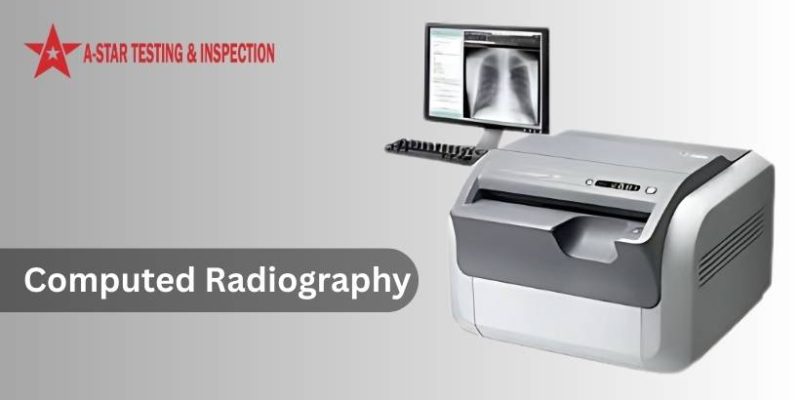
The industrial industry requires increasingly rapid, accurate, and safer ways of inspection. Computed Radiography (CR) has become a groundbreaking Non-Destructive Testing (NDT) methodology that has managed to bring the 100-year-old film radiography practice into the 21st-century modern world. CR offers a solution to inspection teams, providing a potent combination of speed, high accuracy, improved safety, and greater eco-friendliness compared to traditional methods.
A-Star Testing & Inspection, being a qualified expert in the industry, utilises CR to provide services to key sectors like oil and gas, marine/offshore, power plants, manufacturing plants, petrochemical, and other large industrial plants to maintain the integrity of the assets and ensure the safety of operations worldwide.
What is Computed Radiography (CR)?
Computer radiography is a new sophisticated approach to digital imaging technology which substitutes the conventional X-ray film with Photostimulable Phosphor (PSP) plates. These X-ray or gamma-ray sensitive flexible imaging plates can store a latent image.
The most important benefits of CR compared to traditional film radiography are:
- Chemical-Free: No darkrooms or poisonous chemical processing is necessary.
- Shorter Processing Time: Minutes to process images digitally.
- Portable and Flexible: The plates and scanning instruments are very appropriate for remote/offshore inspection and in difficult locations in the industry.
CR is an effective solution for the gap between traditional film and highly developed radiography in real-time digital radiography, and it is a cost-effective and highly flexible NDT solution.
How Computed Radiography Works
CR is a smooth conversion of the analogue capture into the digital evaluation:
- Exposure: The object (e.g., a weld or pipeline) is subjected to a source of X-rays or a gamma ray. The radiation is transmitted through the material, and the rest of the energy pattern is stored as a latent image on the PSP plate.
- Storage: The PSP plate contains the radiation pattern in the form of a trap of electrons – the phosphor layer – this is the latent image.
- Scanning: It is a single feed to a CR scanner, which reads the plate with a focused beam of a laser. The laser excites the trapped electrons, thus releasing the light.
- Digitisation: A light collector and photomultiplier tube transform the emitted light into an electrical signal, and this is digitised into a high-resolution image file.
- Assessment: The final digital image is evaluated by certified inspectors using specialised computer software to precisely detect and quantify the defects such as cracks, porosity and corrosion.
Improved digital workflow will provide the possibility to review the work immediately, the possibility to easily improve the image and repeat inspection without having to re-shoot the object and to provide a safe digital storage.
Benefits of Computed Radiography
The main benefits of CR implementation include operational and environmental benefits:
- High-Resolution Imaging: Provides an unprecedented level of image quality and provides the inspector with a chance to see tiny discontinuities like cracks, porosity, absence of fusion, and corrosion.
- Quick Processing: Reduces the total inspection cycle by an enormous margin compared to the hours spent in film processing and drying with the traditional process.
- Cost-Effective: Reusable imaging plates have removed the repetitive costs of buying, processing and storing the film and chemicals.
- Eco-Friendly: The process is chemistry-free, and therefore, it is a greener NDT preference.
- Digital Archiving: Inspection information is easily saved, accessed, shared and backed up in a safe digital format.
- Portable and Field-Flexible: The small scale of the system allows it to be used in difficult-to-reach locations, such as offshore platforms, remote pipelines, and limited industrial areas.
- Flexible Applications: Can be used to inspect a large variety of materials, thicknesses, and complicated geometries in a wide range of industries.
Industrial Applications of Computed Radiography
CR’s versatility makes it a preferred inspection technique across various high-stakes sectors:
| Industry | Primary CR Applications |
| Oil & Gas | Inspection of pipeline girth welds, pressure vessels, risers, and refinery equipment. |
| Marine & Offshore | Survey of ship hulls, subsea structures, storage tanks, and critical structural welds. |
| Power Generation | Quality control checks on turbine blades, boiler tubes, heat exchangers, and steam lines. |
| Manufacturing | Quality control for castings, forgings, complex assemblies, and aerospace components. |
| Petrochemical | In-service inspection of tanks, process pipelines, and critical plant equipment for corrosion. |
CR is instrumental in ensuring client assets meet rigorous international codes and standards (such as ASME, API, and ISO), thereby minimising operational downtime and ensuring long-term asset integrity.
Computed Radiography vs. Digital Radiography
While both CR and Digital Radiography (DR) are digital inspection methods, they differ fundamentally in technology and application:
| Feature | Computed Radiography (CR) | Digital Radiography (DR) |
| Technology | Photostimulable Phosphor (PSP) plates | Flat-panel detectors (Direct/Indirect) |
| Cost | Cost-effective conversion option; lower initial investment. | Higher initial capital investment. |
| Portability | Highly portable, flexible plates for field use. | Often requires more stationary or specialized setups. |
| Speed | Rapid results (image processed minutes after exposure). | Near real-time imaging (immediate results). |
Summary: CR offers a superb balance of cost, flexibility, and high image quality, making it an ideal choice for operations requiring mobile, large-area, or varied industrial inspections where real-time viewing isn’t strictly necessary.
The benefits of A-Star Testing and Inspection?
Selecting the appropriate NDT partner is important to the operations of your business in terms of safety and efficiency. A-Star Testing and Inspection is a world-renowned NDT leader due to several reasons:
- Skilled Technicians: Our technicians are multi-certified, experienced, and highly skilled personnel who have worked in very complex industrial environments.
- High Tech: We have high-resolution CR scanners and PSP plates that are of the latest technology to ensure maximum visualisation of the inspections.
- Compliance & Certifications: We have significant industry approvals, such as ISO/IEC 17025, and we comply with strict standards of ASME, API, and other classification societies.
- On-Site/Offshore Capability: Our mobile inspection units, fully equipped, are designed to operate fast in remote areas, marine and offshore sites.
- Secure Digital Records: We offer long-term, secure, and readily available digital archiving of all the inspection data.
What is obtained is the correct, timely, and cost-efficient inspections facilitated by modern technology and rendered by skilled hands.
Frequently Asked Questions (FAQs).
Q1: What is the comparison between CR and conventional film radiography?
Ans: CR is much quicker, cleaner, and economical because these imaging plates are reusable and digital scanning provides higher quality digital data management.
Q2: Does it have on-site Computed Radiography?
Ans: Yes. Our portable CR systems are uniquely planned to be efficiently used and deployed to offshore, marine working, and remote industry conditions.
Q3: Is the operator secure when performing CR inspections?
Ans: Yes. CR makes use of controlled radiation. All safety measures are observed when the tests are done by qualified personnel with A-Star so that the safety of the operators and the site personnel is guaranteed.
Q4: What are the leading industries that consume CR?
Ans: The most common are oil and gas, marine and offshore, generation of power generation, manufacturing, and petrochemical or refinery.
Q5: How fast are results with CR?
Ans: The inspection findings are usually reviewed within minutes to a few hours, which has done away with the long delays that come with the traditional film development and drying.
Conclusion
Computed Radiography is a pioneer, and it has revolutionised industrial inspection as it has provided unparalleled precision, speed, cost-effectiveness, and environmental responsibility.
A-Star Testing & Inspection is prepared to offer superior CR services, which is an integrated array of advanced technology, high-compliance and a high-skill pool of personnel. On-site, offshore, or on its own purpose-built premises, collaboration with A-Star means that your critical asset checks are of the best quality and most safety standards, and that they are also reliable in operation and efficient.