
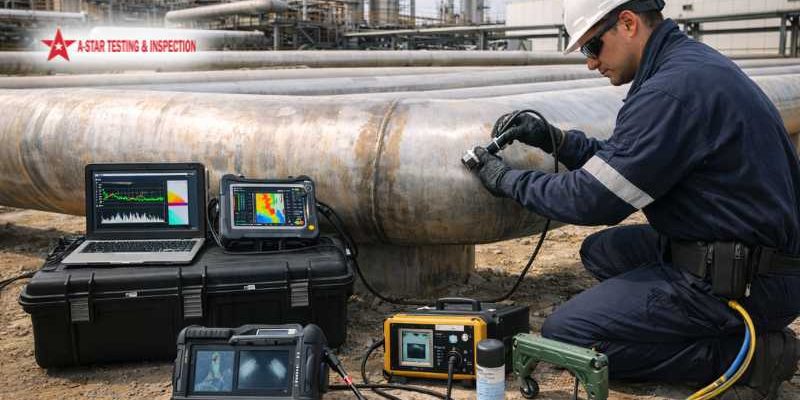
In the high-stakes world of industrial operations, the ability to inspect an asset without damaging it is not just a convenience—it is a safety requirement. Non-destructive testing services (NDT services) are essential for ensuring the safety, reliability, and longevity of critical infrastructure. From massive refineries and power plants to intricate pipeline networks, NDT allows engineers to “see” through metal and concrete to detect defects before they lead to catastrophic failure.
With the aid of a range of sophisticated techniques, such as Ultrasonic Testing (UT), Radiographic Testing (RT), and Phased Array Ultrasonic Testing (PAUT), companies will be able to keep high maintenance standards and compliance levels. Modern preventive maintenance may not be possible without these industrial inspection services since the downtime and emergency repair expenses are greatly minimized.
What Are Non Destructive Testing Services?
Non-destructive testing services refer to various methods of analysis that can be applied to assess the characteristics of a material, component, or system without making the system and its components permanently useless. Since the item is not destroyed in the process, NDT is the least expensive method of quality assurance, inspection of welds, and structural surveillance.
The NDT Toolkit: Core Methods
- Ultrasonic Testing (UT): A high-frequency sound wave is used to measure the thickness of the wall and is used to identify internal volumetric defects.
- Radiographic Testing (RT): Is a test that is used to create an internal map of a part using X-rays or gamma rays, and is best used to locate weld porosity or slag.
- Magnetic Particle Testing (MPT/MT): This is a fast process that is utilized to identify surface and near-surface cracks of ferromagnetic materials.
- Dye Penetrant Testing (DPT/PT): Capillary action is used to demonstrate defects of the surface of non-porous materials.
- Phased Array Ultrasonic Testing (PAUT): This is an advanced form of UT that offers high-resolution color-coded images of complex geometries and corrosion mapping.
- Time of Flight Diffraction (TOFD): This is mostly applied in high-accuracy crack sizing of critical weldments.
The Strategic Benefits of NDT Services
Such an investment is a high-return investment in professional non-destructive testing services for the protection of both personnel and profit:
- Early Signs of Defects: Detect corrosion and fatigue cracks, or manufacturing defects at extremely early stages before they lead to an equipment malfunction.
- Structural Integrity Assessment: Supply the information required in Fitness-for-Service (FFS) tests and other life predictions.
- Regulatory Compliance: Be sure that your plant complies with the rigid standards of ASME, API, and ISO requirements, which are critical to insurance and permits to operate.
- Efficient Maintenance: Shift from reactive repairs to proactive maintenance through understanding which components to repair.
Industrial Applications of NDT Services
The sectors in which our NDT services can help us are the hardest, and there is no compromise when it comes to asset integrity:
Oil & Gas Industry
Our services include full pipeline inspection through internal corrosion and weld anomalies. We also have technicians who deal with the inspection of pressure vessels, so that refineries and gas plants can operate well within safe margins.
Manufacturing and Fabrication
In new construction, we provide weld inspection and identify the absence of fusion, porosity, or cracking in the welding process so that no joint is ever utilised until it satisfies the design code.
Power & Industrial Plants
Boeiler tubes to turbine parts, we make power generation facilities have a high thermal efficiency and safety of operation by ensuring strict inspection of industrial assets.
Service Scope Disclaimer: Our testing services are limited to non-destructive tests, which are purely land-based, onshore, and topside offshore. Underwater or submerged inspection is not offered by us.
Standards and Compliance
To demonstrate that the findings of inspection are internationally accepted and technologically valid, our non-destructive testing services adhere to the frameworks developed in the industry:
- ASME NDT Standards: On boilers and pressure vessels.
- API Pipeline Standards: This is used in the petrochemical, gas, and oil industries.
- Procedures that are ISO-Certified: Having a quality management system that is consistent.
- Risk-Based Inspection (RBI): This is an application of NDT data to prioritize risky assets.
Frequently asked questions: Non-Destructive Testing Services.
Q1: How does NDT differ from destructive testing?
Ans: Destructive testing is testing a sample that breaks down to discover its limits (e.g., tensile test). Services provided by NDT enable you to examine 100 percent of your real functioning components without breaking them.
Q2: What is the most effective method of NDT to determine surface cracks?
Ans: Magnetic Particle Testing (MPT) works best with steel/iron, and Dye Penetrant Testing (DPT) is the most suitable technique in the case of non-magnetic material such as aluminum or stainless steel.
Q3: Is it possible to measure corrosion using NDT?
Ans: Yes. The Ultrasonic Testing (UT) and PAUT are the industry-accepted tools for wall thinning measurements and creating detailed maps of corrosion.
Q4: Do you provide underwater NDT inspection?
Ans: No. Onshore, fabrication yard, and topside non-destructive testing are the only services that we handle.
Conclusion: Collaborating in a Safer Future.
The services of non-destructive testing are also a very important part of industrial safety and structural integrity. Implementing a mixture of standard and state-of-the-art NDT tools, industries will be able to detect the flaws at the earliest stage of their development, comply with authoritative institutions, and maximize the service of their most precious resources.
Professional NDT is the first choice in a setting where any failure can result in enormous consequences.
Visit A-Star Testing & Inspection to talk to an engineer about a tailored NDT program to adopt in the plant and have your assets safe, compliant, and reliable.