
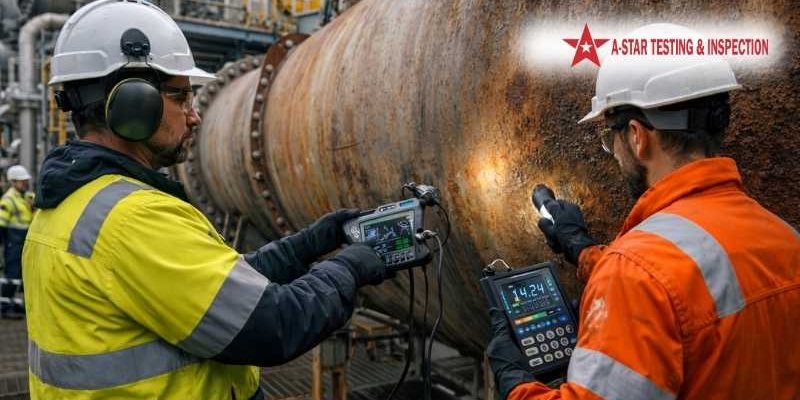
Pressure vessels and storage tanks are the most critical infrastructure in the heart of any refinery, power plant, and chemical facility. These are assets designed to accommodate volatile gases and other dangerous liquids that are subject to heavy machinery and varying temperatures. Due to the amount of energy contained in them, any structural failure can carry devastating effects, whether in the form of huge environmental pollution or loss of lives.
The monitoring of the health of such containers cannot be conducted only visually; it presupposes the use of an advanced asset integrity management strategy. Through a combination of highly developed non-destructive testing (NDT), accurate thickness inspection, and adherence to global engineering standards, the industrial operators will be able to identify microscopic defects prior to them turning out to be macroscopic catastrophes.
Defining the Assets: Pressure Vessels vs. Storage Tanks
Contrary to the common belief of being placed in the same category in maintenance schedules, pressure vessels and storage tanks are subjected to various physical laws and engineering standards.
1. Pressure Vessels
A pressure vessel is a vessel that can maintain a pressure of gases or liquids much greater or lesser than the surrounding air. They are highly controlled because there is a high threat of explosion in the case of rupture.
- Boilers: In power plants, they are critical in the manufacture of steam.
- Heat Exchangers: These are used in the transfer of heat in petrochemical processes.
- Reactors: The chemical manufacturing reaction chambers.
- Separators: In oil and gas, use is necessary to separate fluids into oil, gas, and water.
2. Storage Tanks
These are normally large above-ground storage tanks (ASTs) to store bulk amounts of liquids, such as crude oil, fuels, or water at low or atmospheric pressure. They do not have the explosive potential of high-pressure vessels, but due to their huge volume, these items are a high-risk source of environmental leakage and structural collapse.
Why Regular Inspection is a Non-Negotiable Requirement
The estimated cost of a run-to-failure strategy in the industry sector is more than the cost of proactive maintenance. This regular inspection of pressure vessels and storage tanks has a number of vital benefits:
A. Early Detection of Corrosion Under Insulation (CUI)
Corrosion Under Insulation (CUI) is considered one of the most sinister threats. Since the vessel wall is concealed by means of cladding and insulation, moisture may be trapped against the steel, leading to unseen and quick metal loss. This can be identified by professional NDT without necessarily having to strip the whole of the asset.
B. Prevention of Hydrogen-Induced Cracking (HIC)
In sour service (typical of oil and gas) the hydrogen is able to enter the steel wall resulting in internal blistering and cracking. These internal “laminations” are detected early through regular testing using ultrasonics.
C. Regulatory Compliance and Legal Safety
The use of an uncertified pressure vessel is illegal in most jurisdictions. The compliance with such codes as ASME pressure vessels and API 510/653 allows making sure that your facility is in compliance with the local government safety authorities (like the DOSH in Malaysia).
Common Inspection & Testing Methodologies
An effective integrity program employs both conventional and hi-tech NDT techniques in combination to make sure that not a single defect is overlooked.
1. Ultrasonic Testing (UT) & Thickness Gauging
UT has the capability of inspecting the thickness the most. Technicians can measure the amount of wall thickness left, to less than a millimeter by transmitting sound waves of high frequency through the metal. The first data used in establishing the retirement date of an asset is this data.
2. Phased Array Ultrasonic Testing (PAUT)
In important weld joints, PAUT is used to give a high-resolution image of the inside structure of the weld. This enables one to detect the absence of fusion, porosity, and cracks that UT standard may not detect.
3. Magnetic Particle (MPT) & Dye Penetrant (DPT)
They are the onboard instruments used in checking the welds of tanks and vessels. They are also very useful in showing surface-breaking cracks in the Heat Affected Zone (HAZ) of a weld.
4. Hydrostatic and Pneumatic Testing
Following a significant repair or a new fabrication, the vessel is filled with water (hydrostatic) or air (pneumatic) and pressurized to $1.25\times$ or $1.5\times$ of its Design Pressure. This stress test is used to demonstrate the structural integrity of the whole unit.
Standards and Compliance: The API and ASME Framework
According to these accepted frameworks, professional inspections have to be performed by certified personnel ( API 510/653 authorized inspectors):
- API 510: Regulates the in-service inspection, repair, and modification of pressure vessels.
- API 653: The international standard of inspection, repair, and dismantling of overhead storage tanks.
- ASME Section VI: The initial guideline for the construction and design of new pressure vessels.
- Certified ISO Services: This is because it guarantees the inspection company has a good quality management system for data and reports.
Asset Integrity and Remaining Life Assessment
The final objective of the inspection of pressure vessels and storage tanks is to have an answer to a single question: How long could this asset be used safely?
Engineers apply the results of NDT in complex computations by employing the results of Fitness-for-Service (FFS) evaluations. When a tank was designed to have a thickness of $20mm and is currently having a thickness of 12mm in some of its areas, FFS analysis is used to ascertain whether or not a tank can still maintain its current capacity or whether it is necessary to de-rate (that is, reduce the pressure).
Operational Scope Note
Notice: All pressure vessels and storage tanks inspection and testing services in this instance are applied to above-ground and onshore assets only. We do not service any underwater, subsea, or submerged services.
Frequently asked questions: Pressure Vessel and Storage Tanks.
Q1: What is the main dissimilarity between API 510 and API 653?
Ans: API 510 is limited to pressure vessels (boilers, reactors), whereas API 653 concerns the inspection and repair of the above-ground storage tanks in the atmosphere.
Q2: Does NDT identify external corrosion of the inside of the tank?
Ans: Yes. High-end ultrasonic inspection and PAUT enable technicians to scan internal corrosion and thinning of walls using measurements of the surface.
Q3: What is a Risk-Based Inspection (RBI)?
Ans: RBI is a policy according to which assets are inspected by priority in accordance with the probability of failure and the degree of risk. It enables the plant managers to prioritize the resources on the most significant tanks and vessels.
Q4: Are these services equipped with underwater oil storage cells?
Ans: No. We only cater to the onshore and topside offshore assets.
Conclusion: Securing the Future of Industrial Assets
The industrial world depends on pressure vessels and storage tanks. Their honesty is equated to the security of the plant and the surroundings. By working hard to comply with the NDT standards, adopting API and ASME standard guidelines, and undertaking proactive remaining life assessment, the operators are able to keep their assets in service for decades.
In a business where no one can afford to fail, accurate inspection is the way to go.
To have your pressure vessels and storage tanks inspected to be certified as API and make sure that your operation is safe and conforms to standards, call A-Star Testing & Inspection at the present time and have your inspection done.