
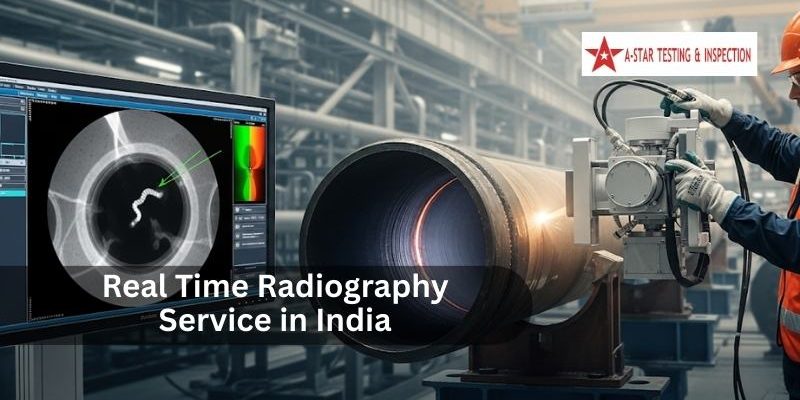
Real Time Radiography (RTR) is a novel non-destructive testing (NDT) technique that offers real-time imaging of internal structures with superior quality and at high resolution. RTR has become an irreplaceable asset in assuring the integrity and safety of different components, unlike traditional industrial radiography, which involves developing films to get the results. This is a cutting-edge X-ray inspection method that can detect defects in real-time quickly and accurately, enhancing efficiencies and reliability in a wide range of industries. RTR has emerged as a fundamental pillar of the latest quality management and asset control through the provision of real-time monitoring and analysis.
What is Real Time Radiography?
Real-time radiography is a type of digital radiography that involves using a source of radiation (usually X-rays) and a digital detector to create a real image on a monitor. There is no darkroom and chemical processing required in this process, which is a significant distinction compared to traditional radiography. The inspection is a real-time application, which enables operators to look at and study defects during the process; therefore, it is a perfect solution for both dynamic and static inspection. The technology has gained popularity in the key sectors of the economy, like oil and gas, aerospace, pipeline construction, and manufacturing.
How Does Real-Time Radiography Work?
The RTR is simple and effective. An X-ray or a gamma ray emitter, or other radiation source, is focused on the object under examination. A digital detector on the other side records the radiations that go through the object. This detector is used to turn the radiation into an electric signal, and a computer is used to process this signal to make a real-time digital picture. This picture is projected on a screen, and the operator can conduct instant flaw detection and analysis. The most important parts are the radiation source, digital detector, and the image processing and display system.
Key Advantages of Real-Time Radiography
- Real-Time picture and flaw identification: The results can be immediately obtained and used to make a decision and to continuously inspect.
- Very high Accuracy and Fine Visualization: Digital images have the best resolution and contrast, thus small defects can be detected.
- Fewer Inspection Times: Film processing and development are removed, and this significantly reduces the total time the inspection takes.
- Appropriate for Static and Moving components: RTR can inspect items on a production line or when they are moving.
- Green: Digital processes eliminate the application of toxic chemicals related to the processing of films.
Applications of Real-Time Radiography
- Weld Inspection: This is critical to pipelines, pressure vessels, and structural components to determine the integrity of the weld.
- Aerospace Industry: This can be used in inspecting the components of the aircraft, such as composite materials, turbine blades, and fuselage structure.
- Petrochemical Plants: These are required to check pressure vessels, tanks, and corrosion and cracks of pipelines.
- Manufacturing: Best used in controlling the quality of castings, composites, and other electronic components, and the internal defects are found out before shipments are made.
Real Time Radiography vs Conventional Radiography
| Feature | Real Time Radiography (RTR) | Conventional Radiography |
| Image Quality | High resolution, instant digital image | High resolution, but requires film processing |
| Time Efficiency | Instantaneous results | Time-consuming due to film development |
| Data Storage | Digital, easily stored and retrieved | Physical films, requiring a large storage space |
| Radiation Exposure | Controlled and can be minimized with automated systems | Can be higher for repeated inspections |
| Cost | High initial equipment cost | Lower initial cost, but higher recurring material costs |
Challenges & Limitations
RTR has numerous limitations, even though it has numerous advantages. The biggest problem is that the equipment is very expensive up front, which may be a big burden on certain firms. Moreover, radiation safety is also a burning issue as safety measures are to be strictly followed, and trained and talented operators are required. The equipment and interpretation of the data are complicated and require special training, which is also problematic.
Future of Real-Time Radiography
RTR is an exciting technology, and we can expect improvements in this field to make it more efficient and more accessible. Artificial intelligence (AI) and machine learning (ML) will allow for easy recognition and analysis of flaws, which will additionally decrease human error. The rapid introduction of the latest digital radiography (DR) and computed radiography (CR) technologies will improve the quality and portability of images. These innovations will make RTR increasingly used in automated inspection systems, and the new age of industrial quality control will begin.
Conclusion
Real-Time Radiography is the technology that modern industries cannot do without, providing an alternative to conventional NDT technologies that is superior in quality. Real-time defect detection, enhanced safety, and unmatched efficiency are some of the features that make it invaluable when it comes to maintaining the integrity of critical assets. With the ever-evolving technology, RTR will have a greater role to play in quality and safety standards across the world. To ensure good and better results, it is important to engage a certified NDT service provider such as A-Star Testing & Inspection with experience and equipment to conduct these high-level inspections accurately.
Frequently Asked Questions (FAQs)
Q1: How do the RTR and conventional radiography differ most?
Ans: The big difference is speed and process. Traditional radiography works with film that requires chemical development, which is a time-consuming activity. RTR is a digital detector that creates an instant image on a screen, which gives instant results.
Q2: Is Real Time Radiography a safe tool to use?
Ans: Yes, provided there are adequate safety measures. Like all radiographic techniques, RTR involves the use of ionizing radiation. The digital character of RTR, however, enables improved control and can be carried out under contained conditions, where radiation levels experienced by operators and the surrounding environment are minimized.
Q3: Which kinds of materials can be checked by means of RTR?
Ans: RTR is universal and can be applied to examine a variety of different materials such as metals (steel, aluminum), composites, plastics, and ceramics. It can also be used effectively in weld inspection and the detection of internal defects in castings and components.
Q4: What is the money savings by RTR to businesses?
Ans: The original cost of equipment is expensive, but RTR is cost-effective in the long run, because inspection time is significantly reduced, the cost of film and chemical termination is eliminated, and defective parts can be corrected immediately, eliminating the production hold-ups.
Q5: What are the qualifications that are required to work on the RTR system?
Ans: RTR system is operated on the basis of special training and certification in terms of NDT and radiation safety. To achieve good results and safe working conditions, operators should understand equipment, image interpretation, and all the applicable safety regulations.