One of the most frequent causes of disastrous failure of pipelines, storage tanks, and other crucial industrial facilities is corrosion. Since corrosion usually takes place on internal surfaces of pipes or the bottom surface of tank floors, it is not visible to the naked eye until it is too late. Unnoticed metal loss causes leakages, structural failures, environmental catastrophes, and huge financial losses.
PAUT inspection of corrosion mapping provides a high-resolution and accurate method of detecting corrosion, quantifying thickness variation, and ensuring the integrity of assets with more accuracy than ever before. Through a series of ultrasonic elements used to scan an area, PAUT creates a complete thermal-like image of the wall of an asset, enabling engineers to visualize the actual topography of a degradation area without ever sawing through the metal.
What is PAUT Inspection?
Phased Array Ultrasonic Testing (PAUT) is a high-tech technique of non-destructive testing, which is based on the use of a probe with a small number of ultrasonic elements (usually 16 to 128). These components are independently pulsed at software-controlled times. This kind of phasing enables steering, scanning, and focusing of the ultrasonic beams without any motion of the probe itself.
Contrary to the conventional procedures, phased array ultrasonic testing services offer a real-time cross-sectional image of the material. It can be inspected on a multi-angle, which is essential in detecting defects that may lie in various directions. PAUT inspection services are to the modern NDT world what the MRI is to the medical sector, with detail that was not previously possible in the industry.
What is Corrosion Mapping?
Corrosion mapping can be described as a methodical procedure of quantifying and representing material thickness on a given surface area. Ultrasonic corrosion mapping produces a continuous data set, rather than reading the spot at a few meter intervals.
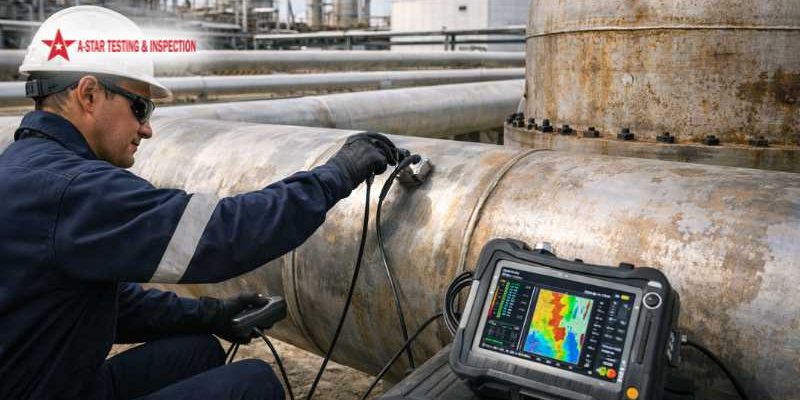
Technicians are able to develop a color coded C-Scan image by determining the location of metal loss and degradation. Here, various colors are used to indicate the remaining wall thickness (e.g., blue full thickness, red severe thinning). This assists in determining the level and degree of corrosion so that maintenance personnel can focus maintenance on the areas of a facility that are most important.
How PAUT Works for Corrosion Mapping
Phased array UT corrosion detection is based on the ability of high-speed electronic scanning. A PAUT probe is used with either an automated or semi-automated crawler that scans the surface of a pipe or tank.
- Multiple Beams: The probe emits a fan of ultrasonic waves.
- High Resolution: Beams yield a thickness reading, and the software stitches them together.
- Complex Geometries: Due to the ability to steer the beams, PAUT is capable of measuring elbows, tees, and nozzles where conventional probes have difficulty maintaining contact.
This multi-angle ultrasonic test feature guarantees that the small “pitting” corrosion is well recorded in high resolution, which would otherwise be easily overlooked by a one-element probe.
Why PAUT is Ideal for Corrosion Detection
Traditional UT involved a technician making thousands of individual readings and has been in use in the industries for years. PAUT has transformed this by:
- 100% Coverage: Spot checking only samples $1\%$ of a surface, whereas PAUT does not.
- Higher Accuracy: Metal loss can be identified with a precision of less than a millimeter.
- Data Archiving: Records are all computerized, which means that one can do a comparison of the rate of corrosion by doing a Year-over-Year comparison.
- Keywords: high-resolution UT inspection, metal loss detection UT.
Applications of PAUT Corrosion Mapping
This service is a high-conversion need in industries where there is no room to fail:
- Oil and Gas Pipelines: It is necessary to monitor corrosion in pipelines of insulated and buried pipelines using this product.
- Storage Tanks & Floors of Tanks: The use of the large floor plates can be quickly mapped to identify the location of under-side of the floor plates corrosion which is on the soil side.
- Refineries and Petrochemical Plants: High-temperature vessels and heat exchangers.
- Offshore Structures: The inspection of risers and structural members is in the hostile splash zone.
- Keywords: tank floor inspection, inspection of vessel integrity.
Benefits of PAUT Inspection Services
The payback period of employing a professional asset integrity inspection team with PAUT is short-term:
- Faster Inspection Time: PAUT is up to 10 x 10 times faster than manual grid mapping.
- Informed Decision Making: Easy to use, non-technical stakeholders can easily get to know where repairs are required due to the use of clear visual maps.
- Longer Life Asset: With regard to the specific areas of thinning, you can do localized repairs, rather than entire multimillion-dollar assets.
- Operational Safety: There is a significant decrease in the probability of unexpected ruptures or leakages.
PAUT vs Conventional UT
In the case of the comparison between UT and PAUT, the decision always narrows down to the resolution that should be achieved. UT The conventional UT is good at rapid thickness measurements of simple parts. But in the case of a high-stakes audit of a critical pipeline, PAUT is the obvious choice. PAUT gives a movie (the C-Scan), whereas conventional UT only gives a snapshot (the A-Scan). In case you require localized pitting or complex corrosion patterns, the conventional UT will most likely fail to detect the very defects that cause failure.
Safety and Compliance in Corrosion Mapping
Compliance with industry is crucial. The inspections by PAUT should comply with tough international standards:
- API 510/570: To check pressure vessels and piping.
- ASME section V: The non-destructive examination standard.
- Trained Staff: Only the ISO 9712 or ASNT Level II/III certified technicians should be used to conduct the inspections.
Guaranteed NDT inspection services will make the data gathered to be not only accurate but also legally defensible in case of safety audits.
How to Choose the Right PAUT Inspection Provider
The future of your facility is safeguarded when you make the right choice of PAUT inspection companies.
- Equipment Grade: They must be 2026 hardware (such as the new Olympus or Zetec equipment).
- Quality of reporting: Requirement: Do you have a sample report? An effective provider of corrosion mapping services must provide 3D graphics and readable, so-called heat maps.
- Sector Expertise: A company that specializes in offshore assets will have varied mobilization ability compared to one that specializes in onshore refineries.
Select specialists in accurate PAUT corrosion mapping services.
Cost of PAUT Corrosion Mapping Services
The price of corrosion mapping is typically estimated in terms of square meters or test points. Although the cost of a PAUT crew per day is more than that of a manual UT crew is, it is frequently cheaper per square meter since the automated scanners are very fast.
Hint: Preventive inspection will save in the long run costs ; the PAUT audit will cost you less than 1/10th the cost of emergency fixing a pipeline.
Future Trends in PAUT Technology
The industry is evolving to a newer PAUT technology, including:
- AI-Assisted Analysis: The program identifies the Red Zones on its own, based on a safety threshold of thickness.
- Remote Robotic Crawlers: Do not require scaffolding or divers to inspect high-rise tanks or subsea pipes.
- Digital Twin Integration: Directly uploading the corrosion maps into a 3D digital representation of the plant to monitor the health of its assets in real-time.
Conclusion: Accurate Corrosion Detection with PAUT
PAUT inspection of corrosion mapping is an effective tool in identifying metal loss, safety, and preservation of assets. Through switching between reactive maintenance and proactive and high-resolution mapping, industries would be able to avoid catastrophic failures and streamline their maintenance budgets. And in the contemporary industrial environment, it is only through being aware of the precise state of your assets that you can be certain to operate with ease.
Get professional PAUT corrosion mapping inspection with us today.
Questions and Answers (FAQ)
Q1. Is PAUT able to penetrate paint or coating?
Ans: Yes. With the Echo-to-Echo methods, PAUT is able to measure the thickness of the steel, but not the thickness of the coating of epoxy or paint on the surface.
Q2. What is the rate of PAUT corrosion mapping?
Ans: A PAUT system, using an automated crawler, can map a pipeline in a maximum of 150mm per second, with thousands of data points per run.
Q3.Can PAUT be used on high-temperature pipes?
Ans: Yes. Custom high-temperature wedges and couplants enable PAUT inspection services to be undertaken on live assets at temperatures up to 200 C or above.
Q4. What is a C-Scan of corrosion mapping?
Ans: The highest level map generated by the PAUT software is called a C-Scan and is a color-coded map. It enables you to view the form of the corrosion through the metal as though you were looking through it.
Related NDT Services
Advanced NDT · Corrosion Mapping · Tank Inspection
Frequently Asked Questions
What is PAUT corrosion mapping?
Phased Array UT scans a surface to build a colour thickness map that pinpoints corrosion, pitting and wall loss on vessels, pipes and tank shells.
Why choose PAUT over conventional UT?
PAUT inspects faster with higher resolution, images complex geometries, and creates a permanent digital record for monitoring corrosion over time.
Where is corrosion mapping applied?
On pressure vessels, piping, storage tanks and structures in oil & gas, refinery and power-plant assets.