Introduction
The most critical assets in use in the oil and gas industry, power generation, petrochemical, manufacturing, and processing sectors are pressure vessels and storage tanks. They keep liquids, gases, and chemicals in different operating conditions, and therefore the structural condition is directly related to plant safety, continuity of operation, and compliance with regulations.
These assets might be weakened over time due to corrosion, fatigue, welding defects, erosion, thermal stress, and environmental exposure. The lack of regular Pressure Vessel Inspection and Storage Tank Inspection can lead to minor defects that can turn into expensive repairs, downtime in production, or even safety accidents.
This guide describes the most effective inspection methods, typical damage mechanisms, applicable standards, and current Industrial NDT Inspection methods that can assist organizations in enhancing Asset Integrity Management and increasing the equipment service life.
Why Regular Inspection Matters
Pressure equipment is essential to industrial facilities to ensure their safety and efficiency. Even highly designed systems undergo slow deterioration during their lifecycle.
Regular inspections assist organisations:
- Early-stage detection of corrosion.
- Identify weld discontinuities
- Reduce unexpected shutdowns
- Improve equipment reliability
- Preventive maintenance planning support.
- Compliance with statutory and industry requirements.
- Extend operational lifespan
- Improve workplace safety
A formatted inspection programme also enables the maintenance teams to make risk-based priorities in repairs rather than responding to failures.
Common Damage Found During Inspection
The knowledge of the typical failure modes assists the maintenance team in selecting the appropriate inspection method.
Internal and External Corrosion
Wall thickness is slowly lost to moisture, chemicals, and process fluids. Outside corrosion can be the result of exposure to the environment, whereas inside corrosion is usually caused by violent media.
Weld Defects
Structural performance can be compromised by incomplete fusion, porosity, slag inclusions, and cracking, which are not immediately detected.
Fatigue Cracking
Cyclic loading, pressure variation, and vibration may also cause cracks that develop with time.
Erosion
Material can be removed by high-velocity fluids containing abrasive particles, which may cause gradual wear to elbows, nozzles, and internal surfaces.
Stress Corrosion Cracking
Some tensile stress combinations and corrosive conditions may create cracks, which cannot be detected after a simple visual inspection.
Best Inspection Practices for Industrial Facilities
1. Perform Scheduled Visual Inspection
The basis of any inspection program is visual inspection.
Inspectors evaluate:
- Surface corrosion
- Leakage
- Coating damage
- Distortion
- Weld condition
- Support structures
- Nozzle connections
Despite their simplicity, visual tests usually provide early warning symptoms that would warrant additional testing.
2. Use Non-Destructive Testing (NDT)
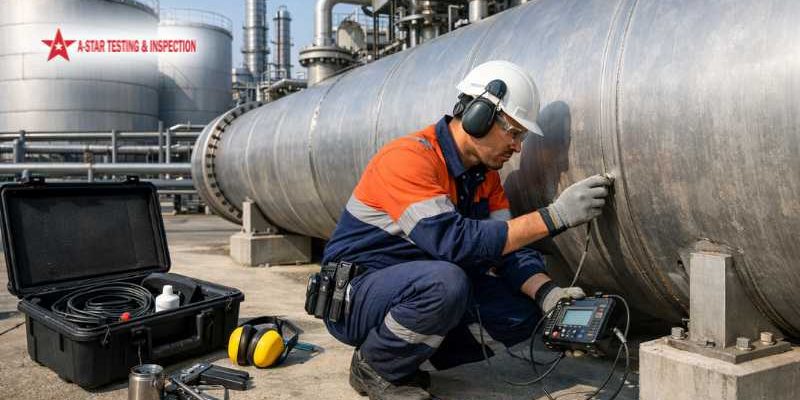
The contemporary Industrial NDT Inspection methods offer precise condition testing without any harm to machinery.
Common methods include:
- Ultrasonic Testing (UT)
- Phased Array Ultrasonic Testing (PAUT)
- Magnetic Particle Testing (MT).
- Dye Penetrant Testing (PT)
- Radiographic Testing (RT)
- Eddy Current Testing (ECT)
- Acoustic Emission Testing (AET)
The techniques have varied uses with different materials based on the thickness, material type, accessibility, and defects that are likely to occur.
3. Monitor Wall Thickness
The monitoring of corrosion is crucial to the long-term health of equipment.
Ultrasonic Thickness Measurement helps engineers:
- Detect metal loss
- Estimate remaining life
- Plan repairs
- Compare past inspection data.
- Improve maintenance planning
High-temperature process equipment is especially useful using regular thickness trending.
4. Follow Risk-Based Inspection (RBI)
Most facilities have now adopted Risk-Based Inspection programs as opposed to inspecting all assets at the same time.
RBI evaluates:
- Probability of failure
- Consequence of failure
- Operating conditions
- Material degradation
- Historical inspection records
This system can assist organizations in distributing the resources of inspection where they are most useful.
5. Inspect Welded Areas Carefully
The majority of structural failures commence in and around welded joints.
The inspection should be directed at:
- Circumferential welds
- Longitudinal welds
- Nozzle welds
- Repair welds
- Heat-affected zones
The internal discontinuities that are not seen on the surface can be detected using advanced ultrasonic methods.
6. Maintain Accurate Inspection Records
Reports on inspections are more valuable as time passes.
Recording the wall thickness measures, corrosion rates, repair, photographs, and NDT results are useful in assisting engineers to determine long-term degradation trends and make sound decisions regarding maintenance.
Records of digital assets also make regulatory audits and subsequent inspections easier.
Industry Standards That Support Safe Operations
Where possible, inspection activities must be based on accepted engineering principles.
Widely used standards are:
- ASME Boiler and Pressure Vessel Code (BPVC)
- Inspection of pressure vessels API 510.
- Storage tank inspection (API 653).
- API 570 to check piping.
- Quality management standards of ISO.
Adherence to established standards enhances uniformity, quality of documentation, and assurance in operations.
Modern Technologies Improving Inspection Quality
The inspection technology is also constantly being improved, and now it can be used to conduct assessments more quickly and more accurately.
The modern facilities are increasingly making use of:
- Digital Radiography
- Drone-assisted visual inspection
- Corrosion mapping
- Phased Array Sonic Testing.
- Video cameras that are remotely controlled.
- Predictive maintenance program based on data.
These technologies save on inspection time and enhance defect reporting and detection.
Choosing the Right Inspection Strategy
Each and every facility is operating under varying conditions.
A good inspection plan ought to take into account:
- Equipment age
- Operating pressure
- Temperature
- Stored media
- Corrosion history
- Industry regulations
- Production criticality
- Previous inspection findings
The synergistic approach of Pressure Equipment Testing, visual inspection, and advanced NDT techniques results in a balanced maintenance strategy, minimizing the operational risk.
Frequently Asked Questions (FAQs)
Q1. What is the frequency of inspection of pressure vessels?
Ans: The frequency of inspection varies based on the operating conditions, the regulations that apply, the age of the equipment, and past inspection outcomes. Risk-based inspection programs help many organizations to decide on appropriate intervals.
Q2. Why is Storage Tank Inspection?
Ans: Storage Tank Inspection detects corrosion, settlement, coating, weld, leakages, and structural damages before they influence significant operational or safety concerns.
Q3. What is the most appropriate NDT technique for pressure equipment?
Ans: No one best method. Ultrasonic Testing, Radiographic Testing, Magnetic Particle Testing, Dye Penetrant Testing, and Phased Array Ultrasonic Testing depend on the material type, the defect location, and the inspection purpose to choose the one.
Q4. Why is Asset Integrity Management important?
Ans: Asset Integrity Management assists organizations in ensuring the safety, reliability, and efficiency of the operation of important equipment by conducting scheduled inspections, maintenance, risk evaluation, and monitoring of performance.
Q5. Will inspections save on maintenance?
Ans: Yes. Early fault identification means that maintenance can be planned, emergency repair minimized, downtime reduced, and the service life of equipment increased, leading to a decrease in the overall operating costs.
Conclusion
Periodic maintenance is not enough to keep industrial equipment in proper condition; an organized inspection plan with the aid of the latest technologies, qualified staff, and accepted industry standards is needed. Periodic checks can be used to detect wear and tear prior to the process becoming operational so that facilities are able to increase safety measures, minimize downtimes, and enhance maintenance schedules.
In the oil and gas, power generation, manufacturing, and petrochemical sectors, the amalgamation of Pressure Vessels and Storage Tank Inspection, Industrial NDT Inspection, Pressure Equipment Testing, and effective Asset Integrity Management forms a proactive attitude to equipment reliability. Investing in regular inspections and data-driven maintenance activities can enable organizations to lengthen the life of assets, enhance the performance of the organization, and ensure that it can meet changing industry demands confidently.
Related NDT Services
Tank Inspection · In-Service Inspection · Advanced NDT
Frequently Asked Questions
What codes govern pressure vessel and tank inspection?
Inspections follow API 510 (pressure vessels), API 653 (storage tanks) and ASME Section V / VIII, covering thickness, corrosion, welds and fitness-for-service.
What NDT is used on pressure vessels and storage tanks?
UT thickness, PAUT, MFL floor scanning, MT/PT on welds, VT and acoustic emission are combined to assess corrosion, cracking and remaining life.
Do you inspect vessels in service?
Yes - A-Star performs both new-construction and in-service inspection to plan maintenance and extend safe operating life.