In manufacturing and energy industries, the quality of a pipeline is as good as the weakest weld. Weld UT Inspection Services, which include pipeline inspection services, are vital to the safety, reliability, and long-term performance of such assets. The weakest links of any high-pressure system are welds; defects such as cracks or insufficiency of fusion may go undetected, resulting in disastrous leakages, ecological risks, and huge financial losses in terms of downtimes.
Through the use of ultrasonic testing of the welds in the pipeline, industries are able to be highly accurate in detecting the internal faults without destroying the asset. The oil and gas refineries, power plants, and industrial piping systems also require these non-destructive testing (NDT) of welds in order to comply with the highest level of global safety and compliance demands.
What Is Weld UT Inspection for Pipelines?
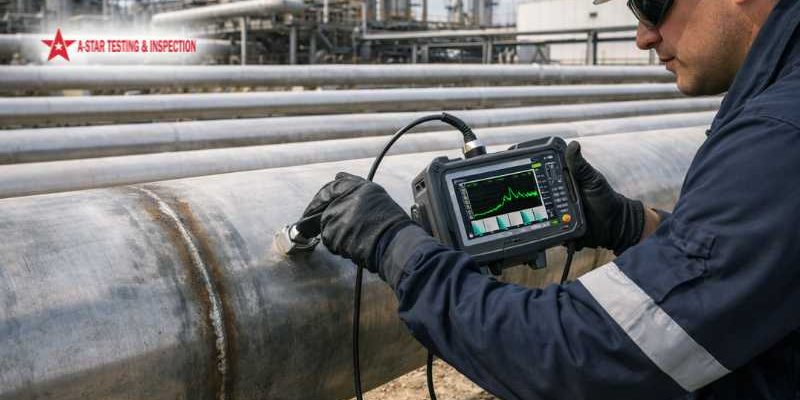
Weld UT inspection services are provided by high-frequency ultrasonic waves, which are used to see through metal. Through a pipeline weld checking, the ultrasonic signals are sent into the weld area. As these waves pass through a discontinuity, e.g., a crack or a void, they bounce back to a transducer. The reflections are then interpreted by analysts to determine the type of flaw, its size, and its location.
In comparison to the conventional visual checks or surface-based inspection, ultrasonic weld inspection can provide:
- Deep Volumetric Penetration: Locating defects in the weld root that are located deep.
- Millimeter Accuracy: The defect height and length are measured accurately.
- Real-time Solutions: On-the-fly data analysis.
Key Benefits of Pipeline Weld UT Inspection
The selection of the professional Pipeline Inspection Weld UT Inspection Services has the following strategic benefits:
- Correct Weld Defect Detection: Early detection of cracks, porosity, and absence of fusion.
- Increased Structural Strength: Making sure that the pipeline can sustain the stated operating pressure.
- Quality Assurance (QA/QC): Establishing compliance (of new welds) with the initial engineering specification.
- Cost Mitigation: It is possible to detect defects in the fabrication or turnaround stage and avoid costly emergency repairs at a later stage.
- Code Compliance: Making sure that all the testing is API/ASME compliant.
Advanced UT Methods for Pipeline Inspection
Based on the complexity of the project, our UT weld inspection services are performed with the help of three main methods:
1. Manual Ultrasonic Testing (UT)
The routine inspection services of pipeline welds are performed as per the industry standard. It is very useful in measuring the thickness and simple defects in standard piping.
2. Phased Array Ultrasonic Testing (PAUT)
An advanced multi-angle inspection technique. PAUT offers color-coded high-resolution imaging of the weld. It is used as the preferred option in the oil and gas pipeline inspection when there is a complication in the geometries.
3. Time of Flight Diffraction (TOFD)
The standard of crack sizing. TOFD is applicable to critical welds, fitness-for-service (FFS) tests, and gives the most precise measure of the vertical extent of a crack.
Common Weld Defects Detected by UT
UT pipeline inspection weld is a very efficient tool in detecting:
- Lack of Fusion: In which the weld metal is unable to connect with the parent pipe.
- Lack of Penetration: In which the penetration of the weld is less than the full depth of the joint.
- Cracks: These comprise fatigue, stress-corrosion, and hydrogen-corrosion cracking.
- Inclusions: Slag or foreign particles that are embedded in the weld.
Service Scope: our services of UT inspection are purely land-based, topside, and fabrication-yard based. We do not offer the inspection of underwater and submerged pipelines.
Standards, Compliance & Comparison
The inspection services of professional UT welding should follow the international codes to receive acceptance among insurers and regulators. We are in operation in complete conformity with:
- ASME Section V & VIII (Pressure Vessels and Boilers).
- API 1104 (Welding of Pipelines)
- Qualification of NDT Personnel ISO 9712.
Inspection Method Comparison
| Method | Detects Internal Flaws? | Defect Sizing Accuracy | Immediate Results? |
| Visual (VT) | No | Low | Yes |
| Magnetic Particle (MT) | No (Surface Only) | Medium | Yes |
| Radiographic (RT) | Yes | Medium | No (Film processing) |
| Ultrasonic (UT/PAUT) | Yes | High | Yes |
FAQs- Pipeline Weld UT Inspection.
Q1: What is the key benefit of UT compared to X-ray (RT)?
Ans: UT inspection provides real-time results and does not mandate the site to be evacuated because of the risk of radiation. It is more precise in measuring the depth and height of a crack.
Q2: Is it possible to inspect stainless steel or duplex welds by UT?
Ans: Yes, but with these materials, special probes and qualified technicians are needed because of the structure of its grain. We also offer the services of pipeline weld inspection and have specialists in exotic alloy testing.
Q3: What is it that makes me know whether my pipeline requires PAUT or manual UT?
Ans: UT (UT) Manual: UT is usually adequate for standard pipes, but slimmer. PAUT is used for the high-pressure lines, thick-walled vessels, or projects that need a digital record of the whole weld.
Q4: Do you provide underwater pipeline welding tests?
Ans: No. We only inspected pipelines and welding on the topside offshore and the fabrication yard.
Conclusion: Safeguarding Your Infrastructure
The last piece of protection in the regulation of weld quality and conformity is Pipeline Inspection Weld UT Inspection Services. The industries can reach a certain degree of confidence that cannot be offered by manual visual checks by integrating traditional manual UT and superior technologies PAUT and TOFD.
In a facility where safety and production continuity are not an option, ultrasonic testing is the most reliable NDT solution in the market.
Call A-Star Testing & Inspection to conduct a certified weld UT inspection and ensure the long-term integrity of your pipeline network.